














TL;DR:
- A lay stake calculator determines the precise amount to lay on a betting exchange to hedge bookmaker bets and guarantee profits. It uses inputs like back stake, odds, and commission, providing information on liability and optimal lay stakes for various betting strategies. Using this calculator minimizes errors, manages risk, and enhances profitability, especially for matched betting in Canada.
A lay stake calculator is a betting tool that computes the exact amount you need to lay against a selection on a betting exchange to hedge your bookmaker bet and lock in a profit regardless of the outcome. If you are exploring matched betting for the first time, this calculator is the single most important tool you will use. It takes your back stake, back odds, lay odds, and exchange commission as inputs, then outputs your lay stake, liability, and guaranteed profit or loss. Exchanges like Betfair and Smarkets are where these lay bets are placed, and without accurate calculations, you are guessing rather than profiting.
What is a lay stake calculator and how does it work?
A lay stake calculator works by applying a specific formula to balance your bookmaker bet against an opposing bet on an exchange. The standard lay stake formula is:

Lay Stake = (Back Stake × Back Odds) ÷ (Lay Odds − Commission)
Each variable in this formula has a direct impact on your result, so understanding all four is non-negotiable.
- Back Stake: The amount you placed with the bookmaker. If you bet $50 on a team to win, your back stake is $50.
- Back Odds: The decimal odds offered by the bookmaker. Decimal format is standard for these calculations. If the bookmaker offers 3.00, that is your back odds figure.
- Lay Odds: The price available on the exchange for laying the same selection. This is the odds at which other bettors are willing to back the outcome you are laying against.
- Exchange Commission: Betfair charges 5% by default, while Smarkets typically charges 2%. Commission rates typically range from 2% to 5% and must be factored in to get an accurate result. Ignoring commission means your lay stake will be slightly off, which eats into your profit.
Here is a simple worked example. Say you back a selection at 3.00 with a $50 stake at your bookmaker. The lay odds on Betfair are 3.10, and commission is 5% (or 0.05).
Lay Stake = (50 × 3.00) ÷ (3.10 − 0.05) = 150 ÷ 3.05 = $49.18
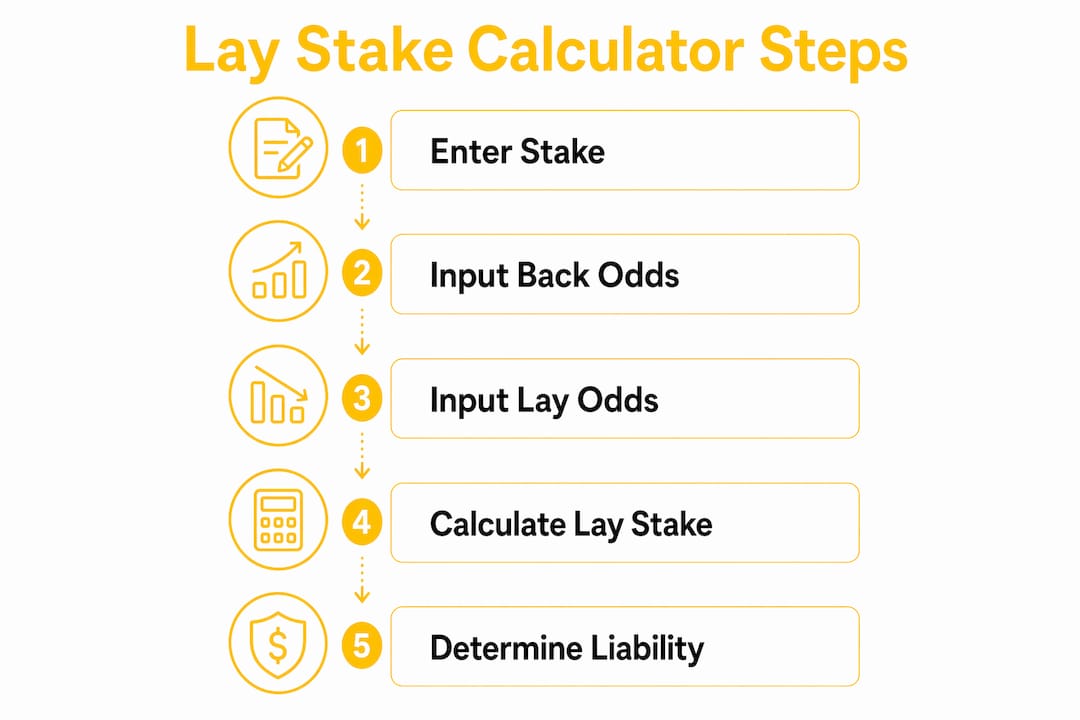
Your liability on the exchange is calculated as Lay Stake × (Lay Odds − 1), which in this case is 49.18 × 2.10 = $103.28. That is the amount Betfair holds in reserve until the bet settles. Knowing your liability upfront tells you exactly how much cash you need in your exchange account before placing the lay bet.
Pro Tip: Always use decimal odds when entering figures into a lay stake calculator. If your bookmaker displays fractional odds like 2/1, use a free odds converter to convert them before calculating.
Why use a lay stake calculator for matched betting?
The core benefit of using a lay stake calculator is risk control. Matched betting calculators remove manual math entirely, letting you “green up” a bet so that equal profit is secured regardless of whether your selection wins or loses. That is the whole point of matched betting: you are not gambling on an outcome, you are exploiting the mathematical relationship between two bets.
Here is why Canadian bettors specifically benefit from using one:
- Eliminates human error. Manual calculations with four variables are error-prone. A single wrong digit in your lay odds can flip a small profit into a real loss. Input accuracy is critical because many bettors lose money due to input errors rather than bad odds.
- Minimizes qualifying losses. When you use a bookmaker’s welcome bonus, you must place a qualifying bet first. The calculator shows you exactly how to minimize the loss on that qualifying bet before you unlock the free bet.
- Maximizes free bet value. Free bets come in two types: Stake Not Returned (SNR) and Stake Returned (SR). Each type uses a slightly different formula, and the calculator adjusts automatically to show you the optimal lay stake for each.
- Manages exchange liability. Knowing your liability and potential profit before you place a bet means you never get caught short of funds on the exchange. This is especially relevant on Betfair, where liability is held immediately upon placing the lay bet.
- Saves time and builds confidence. Once you see the numbers laid out clearly, the process feels far less intimidating. You place bets with certainty rather than anxiety.
Pro Tip: When working with SNR free bets, your expected return is typically 70% to 80% of the free bet value after the qualifying loss. A calculator shows you this figure instantly so you know what to expect before committing.
Common mistakes when using lay stake calculators
Getting the formula right is one thing. Entering the correct data is another. Most errors that cost bettors money come from the input side, not the formula itself.
- Confusing odds formats. Entering fractional odds (5/2) where the calculator expects decimal odds (3.50) produces a completely wrong lay stake. Always confirm the format the calculator requires before entering any figure.
- Using the wrong commission rate. Betfair’s standard rate is 5%, but if you have earned a loyalty discount or are using Smarkets at 2%, entering the wrong rate skews every output. Verify your commission rate every time before calculating, since rates can change.
- Ignoring liability. Some beginners focus only on the lay stake figure and forget to check whether they have enough funds in their exchange account to cover the liability. If your account balance is too low, the bet will not go through.
- Not adjusting for free bet type. An SNR free bet and an SR free bet require different lay stakes. Using the SNR formula on an SR bet leaves money on the table. Always select the correct bet type in the calculator.
- Failing to double-check outputs before placing. Odds move quickly. If you calculate at 3.10 but the lay odds shift to 3.20 by the time you place the bet, your figures are outdated. Recalculate whenever odds change before confirming the lay.
The Qualifying Bets Guide on Thinkbonus walks through these scenarios in detail, which is worth reading before you place your first qualifying bet.
What types of lay stake calculators are available?
Not all lay stake calculators are built the same. Different betting strategies require different tools, and knowing which one to use saves you from applying the wrong formula to the wrong situation.
The standard matched betting calculator covers qualifying bets and free bets (both SNR and SR). This is the starting point for most Canadian bettors working through welcome offers and reload promotions. Beyond that, several specialized variations exist.
| Calculator type | Best used for | Key adjustment |
|---|---|---|
| Standard lay stake | Qualifying bets and free bets | Applies SNR or SR formula based on bet type |
| Sequential lay calculator | Series bets where lay is placed across multiple events | Adjusts stake across each leg of the sequence |
| Partial lay calculator | When exchange liquidity is low | Calculates optimal partial lay to reduce liability |
| Each way lay calculator | Horse racing each way bets | Splits calculation across win and place portions |
| Dutching calculator | Backing multiple selections to guarantee profit | Distributes stake across selections rather than laying |
The sequential lay calculator on Thinkbonus is particularly useful for promotions that require a series of bets before a free bet is released. Instead of calculating each leg manually, the tool handles the full sequence in one step. For horse racing fans, the each way calculator accounts for both the win and place portions of a bet, which a standard lay stake calculator does not cover. And if you are working with laying multiples, a dedicated tool is far more reliable than trying to adapt a single-event formula.
The key takeaway is that lay stake calculators provide liability and potential profit alongside the lay stake, giving you the full picture to manage your bets and bankroll allocation across every strategy type.
Key takeaways
A lay stake calculator is the foundation of profitable matched betting because it removes guesswork and replaces it with precise, repeatable math.
| Point | Details |
|---|---|
| Core formula | Lay Stake = (Back Stake × Back Odds) ÷ (Lay Odds − Commission) is the calculation every tool uses. |
| Liability awareness | Always check your liability figure before placing a lay bet to confirm you have sufficient exchange funds. |
| Commission matters | Use your actual exchange commission rate (2% to 5%) or your outputs will be inaccurate. |
| Free bet type selection | Choose SNR or SR in the calculator to match your actual free bet terms and maximize returns. |
| Use specialized tools | Sequential, each way, and partial lay calculators exist for strategies beyond standard qualifying bets. |
Why I think most bettors underestimate this tool
From my experience working through hundreds of bookmaker promotions, the lay stake calculator is the one tool that separates bettors who consistently profit from those who break even or lose. Most beginners treat it as a nice-to-have rather than a must-have. That mindset is expensive.
The part that surprises people most is the liability figure. New bettors often fund their exchange account with just enough to cover the lay stake, then discover the exchange holds significantly more in reserve. On a $50 lay stake at odds of 4.00, your liability is $150. That is three times the lay stake sitting locked in your account until the bet settles. Understanding this upfront changes how you manage your bankroll entirely.
For Canadian bettors specifically, exchange choice matters. Betfair operates in Canada and charges 5% commission by default, but that rate drops with volume. Smarkets offers a flat 2% rate, which meaningfully improves your profit on every single bet. Running the same calculation at 2% versus 5% commission on a $100 back stake at 3.00 odds produces noticeably different lay stakes and profit figures. The calculator makes that difference visible immediately.
My honest advice: treat the calculator as your first step, not your last check. Calculate before you place, then recalculate if odds move. The few seconds it takes will protect your bankroll far better than any betting instinct ever will.
— Mantas
Start calculating smarter with Thinkbonus
Thinkbonus gives Canadian bettors everything needed to put lay stake calculations into practice right away. The matched betting calculator handles qualifying bets, SNR free bets, and SR free bets in one clean interface, no manual math required. If you are just getting started, the Matched Betting Academy walks you through every concept step by step, from your first qualifying bet to advanced promotion strategies.

The tools are free to use, and the guides are written specifically for the Canadian market, covering exchanges available here and promotions from Canadian-facing bookmakers. Whether you are working through your first welcome bonus or optimizing a reload offer, Thinkbonus has the calculator and the context to help you do it right.
FAQ
What is a lay stake calculator used for?
A lay stake calculator computes the exact amount to lay on a betting exchange to hedge a bookmaker bet, outputting the lay stake, liability, and guaranteed profit or loss based on your inputs.
What inputs does a lay stake calculator need?
You need four inputs: your back stake, the bookmaker’s back odds in decimal format, the exchange lay odds, and the exchange commission rate (typically 2% to 5%).
How is liability calculated in lay betting?
Liability is calculated as Lay Stake × (Lay Odds − 1). This is the amount the exchange holds in your account until the bet settles, and it must be available as a cash balance before placing the lay bet.
What is the difference between SNR and SR free bets in a calculator?
SNR (Stake Not Returned) free bets use a different lay stake formula than SR (Stake Returned) bets because the stake is not returned with winnings. Selecting the wrong type in the calculator produces an incorrect lay stake and reduces your profit.
Do I need a different calculator for sequential or each way bets?
Yes. Standard lay stake calculators cover single-event bets. Sequential lays and each way bets require specialized calculators that adjust the formula for multiple legs or split win and place portions respectively.