














TL;DR:
- A betting log is a structured record of every wager, including details like date, odds, stake, and outcome, to analyze performance objectively. Regular early entry and simple fields foster discipline, enabling insights into metrics like CLV and ROI for long-term profitability. Reviewing logs weekly and monthly helps bettors identify leaks, improve strategies, and maintain behavioral accountability over time.
A betting log is defined as a structured record of every wager you place, capturing details like date, odds, stake, bookmaker, and outcome in one organized system. Most bettors skip this step entirely, and that is exactly why most bettors lose money without understanding why. A betting log transforms your results from a blurry memory into clear, honest data you can actually learn from. Whether you are just starting out or you have been betting for years, understanding what is a betting log explained properly will change how you approach every single wager.

What is a betting log and why does it matter?
A betting log is a detailed, objective record of all your wagers, built to give you unbiased data for analyzing and improving your performance. According to bet tracking research, a basic log captures at minimum five fields per bet, while advanced logs track 12–15 fields for deeper analysis. That gap between five and fifteen fields is where casual bettors and serious bettors part ways.
The core purpose of a betting log is not organization for its own sake. It exists to make you less wrong over time by honestly identifying your betting flaws and strengths. Without a log, your brain fills in the gaps with selective memory, and you will almost always remember your wins more vividly than your losses. That cognitive bias is called survivorship bias, and it quietly destroys bankrolls.
A betting log also acts as an external record that captures wins and losses without the memory editing your brain naturally does. Think of it like a financial statement for your betting activity. You would not run a business without tracking income and expenses, and your betting bankroll deserves the same discipline.
What should a betting log include?
The betting log definition starts with five non-negotiable fields and expands from there based on your goals. Here is how the two levels compare:
| Field | Basic log | Advanced log |
|---|---|---|
| Date | ✓ | ✓ |
| Bet description | ✓ | ✓ |
| Odds | ✓ | ✓ |
| Stake | ✓ | ✓ |
| Result (win/loss) | ✓ | ✓ |
| Bookmaker | ✓ | |
| Closing odds | ✓ | |
| Closing Line Value (CLV) | ✓ | |
| Confidence rating | ✓ | |
| Expected Value (EV) | ✓ | |
| Notes on reasoning | ✓ | |
| Sport and market type | ✓ |
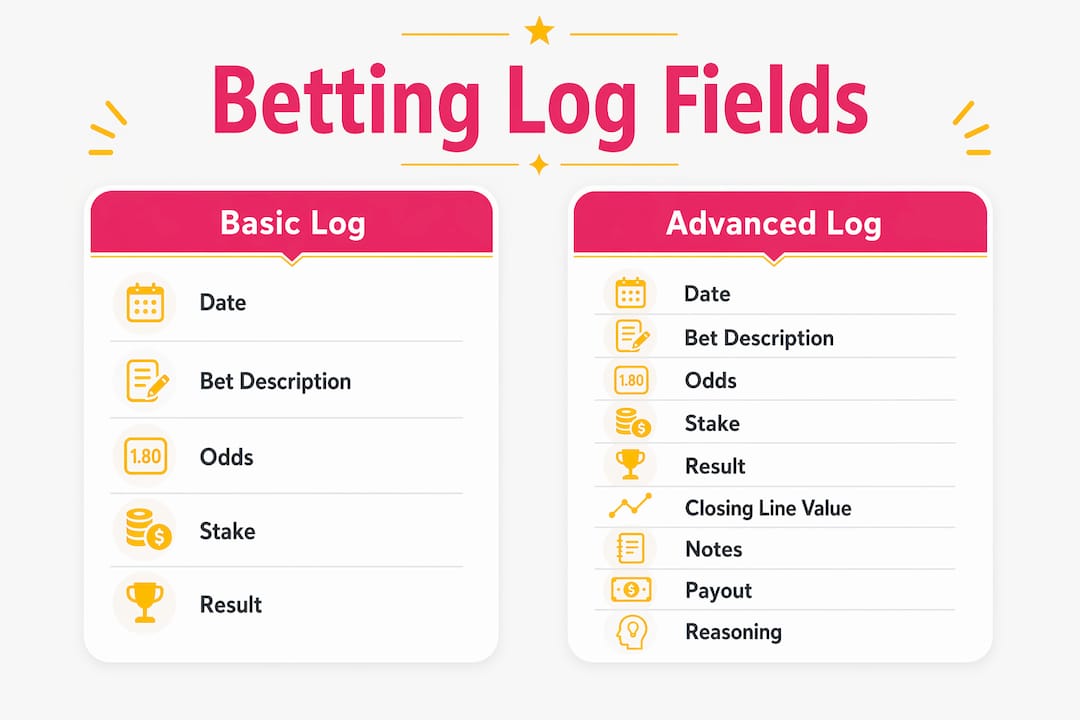
The basic five fields tell you what happened. The advanced fields tell you why it happened and whether your process was sound. For example, the bookmaker column lets you spot which sportsbooks give you the best value over time. The confidence rating column reveals whether your high-conviction bets actually perform better than your gut-feel wagers.
Notes on reasoning deserve special attention. Research confirms that notes about the “why” behind each bet transform a log from a simple record into a process improvement tool. A note does not need to be long. Something like “backed the home team based on injury news” is enough to diagnose sharp versus sloppy behavior when you review it later.
Pro Tip: If you use the Thinkbonus single bet calculator before placing a wager, copy the payout figure directly into your log. It removes any math errors and keeps your records clean.
Beginners should start with the five basic columns and resist the urge to build a complicated spreadsheet on day one. Overcomplicated logs get abandoned, and an abandoned log is worse than no log at all.
Which metrics matter most when analyzing a betting log?
The two metrics that matter most in any betting log are Return on Investment (ROI) and Closing Line Value (CLV). ROI tells you how much profit you are generating relative to your total stakes. CLV tells you something more powerful: whether you are consistently getting better odds than the market’s final price.
Here is why CLV is the metric experienced bettors prioritize. Positive CLV over 1.5% across 200 or more bets predicts long-term profit more reliably than win rate alone. Win rate fluctuates with variance. CLV reflects genuine pricing skill and edge. A bettor with a 45% win rate but consistent positive CLV is in a far stronger position than one with a 55% win rate and negative CLV.
Beyond ROI and CLV, these metrics add real insight to your log analysis:
- Win rate by market: Reveals which bet types you actually understand versus which ones you are guessing on.
- Average odds: Tracks whether you are consistently finding value or settling for short prices.
- Expected Value (EV): Measures the theoretical profit per bet based on your estimated probability versus the odds offered.
- Profit and loss by bookmaker: Shows which platforms offer you the best long-term value, which matters especially when tracking bookmaker promotions.
- Stake variance: Identifies whether you are betting more on emotional picks versus well-researched ones.
Raw profit and loss numbers alone are misleading in the short term. A losing month with strong CLV numbers is actually a sign of a healthy process. A winning month with poor CLV numbers is a warning sign dressed up as success. Your log gives you the data to tell the difference.
How to keep and maintain a betting log effectively
The single most important habit in maintaining a betting log is logging each bet immediately after you place it. Immediate data entry preserves honest context, including your reasoning, timing, and whether the bet was impulsive. Batch logging at the end of the week introduces memory gaps and tempts you to quietly skip the bets you would rather forget.
Here is a simple process to build the habit:
- Place your bet. Open your log before you close the sportsbook tab.
- Enter the five basic fields. Date, description, odds, stake, and bookmaker take under 60 seconds.
- Add a one-line note. Write the reason you placed the bet while it is still fresh.
- Record the result the same day the event settles. Do not let results pile up.
- Calculate CLV within 24 hours of the event. Compare your entry odds to the closing line from the bookmaker or a reference exchange.
For tools, you have two main options: a spreadsheet or a dedicated tracking app. Google Sheets works well for beginners because it is free, flexible, and private. Apps like Pikkit, Bettin.gs, and BettorEdge automate ROI and CLV tracking, but they involve data sharing with third parties, so consider your privacy preferences before connecting your accounts.
Pro Tip: The medium matters far less than the consistency. A basic Google Sheet you update every day beats a sophisticated app you open once a week.
The biggest pitfall is overcomplication. Most abandoned logs fail because of complexity and delayed logging. Start simple, build the habit, and add fields only when you are genuinely using the data they produce.
How to review your betting log data for real improvement
Reviewing your log on a regular schedule turns raw data into better decisions. The recommended cycle is a quick weekly check and a deeper monthly review. Experts suggest spending around 30 minutes monthly on a deep analysis to identify poor odds selection and emotional betting patterns.
Your weekly check should answer three questions: Did I log every bet? Are there any obvious emotional bets I should flag? Is my bankroll tracking as expected? The monthly review goes deeper. Here is what to look at:
| Review area | What to look for |
|---|---|
| CLV trend | Are you consistently beating closing lines? |
| Performance by sport | Which markets are profitable and which are draining your bankroll? |
| Performance by bookmaker | Which platforms give you the best value? |
| Confidence rating accuracy | Do your high-confidence bets outperform your low-confidence ones? |
| Notes review | Are there patterns in your reasoning on losing bets? |
Segmenting your data by sport, market, and bookmaker is where most bettors find their biggest leaks. You might discover that your soccer bets are consistently profitable while your tennis bets are quietly losing money. Without the log, you would never see that pattern. You would just feel like betting is not working.
A disciplined log combats survivorship bias by capturing all bets, including the impulsive ones you placed at midnight and the ones you lost on a hunch. Those are the bets that reveal the most about your actual behavior. Reviewing them honestly is uncomfortable, but it is the fastest path to improvement. For a broader framework on how structured review cycles work across performance-based activities, trading performance reviews offer useful parallels that bettors can adapt directly.
Key takeaways
A betting log is the single most effective tool for separating disciplined bettors from emotional ones, and CLV is the metric that reveals whether your process is genuinely profitable.
| Point | Details |
|---|---|
| Core betting log definition | A log records every bet’s date, odds, stake, bookmaker, and outcome for objective analysis. |
| Start simple, then expand | Begin with five basic fields and add CLV and confidence ratings only after building the logging habit. |
| CLV beats win rate | Positive CLV over 1.5% across 200 or more bets predicts long-term profit better than win rate. |
| Log immediately | Enter each bet right after placing it to preserve honest context and avoid memory gaps. |
| Review on a schedule | Run a weekly check and a 30-minute monthly deep dive to spot leaks and refine your strategy. |
Why I think most bettors are solving the wrong problem
Most bettors who struggle think their problem is picking winners. After spending years tracking bets and reviewing logs, I can tell you the real problem is almost always process, not picks.
I have seen bettors with genuinely good instincts lose money consistently because they had no record of what they were doing. They could not tell you their ROI by market, their average odds, or whether their confident bets outperformed their casual ones. They were flying blind and calling it experience.
The shift that a betting log creates is behavioral, not just analytical. When you know every bet is going into the record, you think twice before placing a sloppy one. The log holds you accountable in a way that memory never can. I have caught myself about to place a bet I could not write a coherent reason for. The act of opening the log stopped me.
My honest advice: do not start with CLV tracking. Do not build a 15-column spreadsheet on day one. Start with five fields and a one-line note per bet. Do that for 30 days without missing a single entry. By the end of that month, you will have more useful data about your betting behavior than most people accumulate in years. The step-by-step approach to betting is always more sustainable than trying to do everything at once.
The goal of a betting log is not to feel organized. It is to make you less wrong, one bet at a time.
— Mantas
How Thinkbonus can support your betting log journey

Thinkbonus is built for exactly this kind of disciplined, data-driven approach to betting. Whether you are setting up your first log or refining an advanced tracking system, the Matched Betting Academy walks you through every stage with clear tutorials and practical tools. You will find calculators that make logging payout figures fast and accurate, including the double bet calculator for more complex wagers. If you are ready to put your log data to work and start extracting real value from bookmaker promotions, the matched betting guide is the best place to start. Thinkbonus gives you the structure to turn your betting records into consistent, trackable profit.
FAQ
What is the betting log definition in simple terms?
A betting log is a record of every wager you place, including the date, odds, stake, bookmaker, and result. It gives you objective data to analyze your performance and improve your decisions over time.
How many fields should a betting log include?
A basic betting log needs at least five fields: date, bet description, odds, stake, and result. Advanced logs include 12–15 fields such as Closing Line Value, bookmaker, and confidence ratings for deeper analysis.
What is Closing Line Value and why does it belong in a betting log?
Closing Line Value (CLV) measures whether you got better odds than the market’s final price before an event starts. Positive CLV over 1.5% across 200 or more bets is a stronger predictor of long-term profit than win rate alone.
How often should I review my betting log?
Run a quick weekly check to confirm all bets are logged and your bankroll is on track. Spend around 30 minutes monthly on a deeper review to identify poor odds selection, emotional bets, and market-specific leaks.
What is the best tool for keeping a betting log?
Google Sheets works well for beginners because it is free, private, and flexible. Apps like Pikkit, Bettin.gs, and BettorEdge automate tracking but involve data sharing. The tool matters less than logging every bet immediately after placing it.