














TL;DR:
- Step-by-step betting guides establish a structured process focusing on control through predefined rules and disciplined tracking. They help bettors avoid emotional mistakes like chasing losses and overbetting by emphasizing bankroll management, market filtering, and consistent review. Integrating responsible gambling tools ensures sustainable betting practices, making guides essential frameworks for long-term profitability.
Step-by-step betting guides are structured frameworks that define exactly when, how much, and on what to bet, removing guesswork from every decision you make. Most bettors lose not because they pick bad outcomes but because they have no system controlling their behavior between picks. That gap is precisely where structured betting guides deliver their value. Whether you are placing your first wager on an NHL game or refining an existing approach, understanding the role of step-by-step betting guides is the single most important shift you can make toward consistent, profitable betting.
How step-by-step betting guides improve execution and discipline
The core function of a betting guide is not prediction. It is control. ThinkBonus defines a betting plan as a set of fixed rules governing stake size, market selection, and timing, with measurable results tracked over time. That definition matters because it shifts your focus away from “will this bet win?” toward “am I following my process correctly?”
When you operate without predefined rules, two destructive patterns emerge. You chase losses by increasing stakes after a bad run, or you overbetting after wins because confidence spikes. Both behaviors erode your bankroll faster than any single losing bet. Loss aversion causes many bettors to fluctuate their stakes emotionally, which directly harms their long-term edge.
A well-built guide prevents this with three specific mechanisms:
- Fixed staking rules: You decide your unit size before the season starts, not in the moment. This keeps bet sizing rational regardless of recent results.
- Market filters: The guide specifies which sports, leagues, and bet types are in scope. You do not deviate because a hot tip appears outside your defined markets.
- Bet logging with reasoning: Every bet gets recorded with the rationale behind it, not just the outcome. This habit builds accountability and reveals patterns over time.
Pro Tip: Record the reason for every bet before you place it, not after. Reviewing your reasoning against outcomes over 200+ bets reveals which thought patterns actually produce edge and which ones just feel confident.
Tracking is where most bettors skip a step. Reviewing ROI by sport, bet type, and average edge over a large sample exposes leaks that are completely invisible in the short term. A monthly audit of your bet log is not optional if you want to improve. It is the feedback loop that makes the entire system work.
What core components do effective betting guides cover?
A complete betting guide covers four building blocks. Miss any one of them and the system develops a hole that will cost you money over time.

Bankroll management and unit sizing come first. The two most common methods are flat staking, where every bet is the same fixed unit regardless of confidence, and fractional Kelly, where unit size scales with your calculated edge. Flat staking is safer for beginners because it removes the temptation to size up on “sure things.” Fractional Kelly produces higher returns over time but requires accurate edge estimates, which take experience to develop.
Odds shopping and Closing Line Value come second. NFL spread differences of half a point across books shift your long-term win rate by 1.5%. That number sounds small until you realize it compounds across hundreds of bets per year. Opening accounts at multiple sportsbooks and comparing lines before every bet is the highest-value habit in sports betting. The key metric to measure bet quality is whether you beat the closing line rather than whether individual bets win or lose. Consistently betting at prices longer than the closing line can yield 2 to 4% ROI without any deeper analysis.
Expected value (+EV) betting is the third pillar. ThinkBonus explains +EV betting as identifying bets where the sportsbook’s implied probability is lower than the true probability of the outcome. Every profitable bettor, whether they know it or not, is hunting for positive expected value. A guide that does not teach you to calculate or recognize +EV is incomplete.
Market specialization rounds out the four components. The table below compares the main staking approaches and their trade-offs:
| Staking method | Best for | Key trade-off |
|---|---|---|
| Flat staking | Beginners and low-variance markets | Lower ceiling but protects bankroll |
| Fractional Kelly | Experienced bettors with edge estimates | Higher returns, requires accurate probability |
| Percentage of bankroll | Adapts to bankroll growth or decline | Bet size changes constantly, harder to track |
Specialized bettors outperform generalists according to data from the UNLV International Gaming Institute. Focusing on one or two sports or markets where you have genuine knowledge gives your edge a real foundation. Spreading across ten sports dilutes your attention and your results.
How guides integrate responsible gambling and player protection
Modern step-by-step betting guides do not treat responsible gambling as a disclaimer at the bottom of the page. They build it into the system from the start. The Gambling Commission’s 2025 updates mandate easier deposit limit controls and periodic notifications to customers about fund protection. That regulatory shift reflects a broader understanding that consumer controls reduce harm and build confidence.
A responsible gambling checklist inside a betting guide typically covers:
- Setting a hard deposit limit before funding any account
- Defining a maximum monthly loss threshold and treating it as a stop point
- Scheduling regular breaks from betting, at least one week per month
- Using self-exclusion tools if betting starts to feel compulsive rather than systematic
Simpler promotions and product limits introduced by the Gambling Commission lower the risk of confusion and harm from complex bonus structures. When a guide explains these tools clearly, you gain practical control over your betting environment rather than reacting to it.
Pro Tip: Set your deposit limit before you fund your account, not after your first losing session. Changing limits in the heat of a losing streak is exactly when the decision is least reliable.
For Canadian bettors, provincial regulators like the Alcohol and Gaming Commission of Ontario (AGCO) provide similar player protection frameworks. Any guide worth following will point you toward these tools and explain how to use them as part of your betting infrastructure, not as an afterthought.
How to practically apply a betting guide to your own approach
Building a betting system from a guide follows a clear sequence. Skipping steps early creates gaps that show up as costly mistakes later.
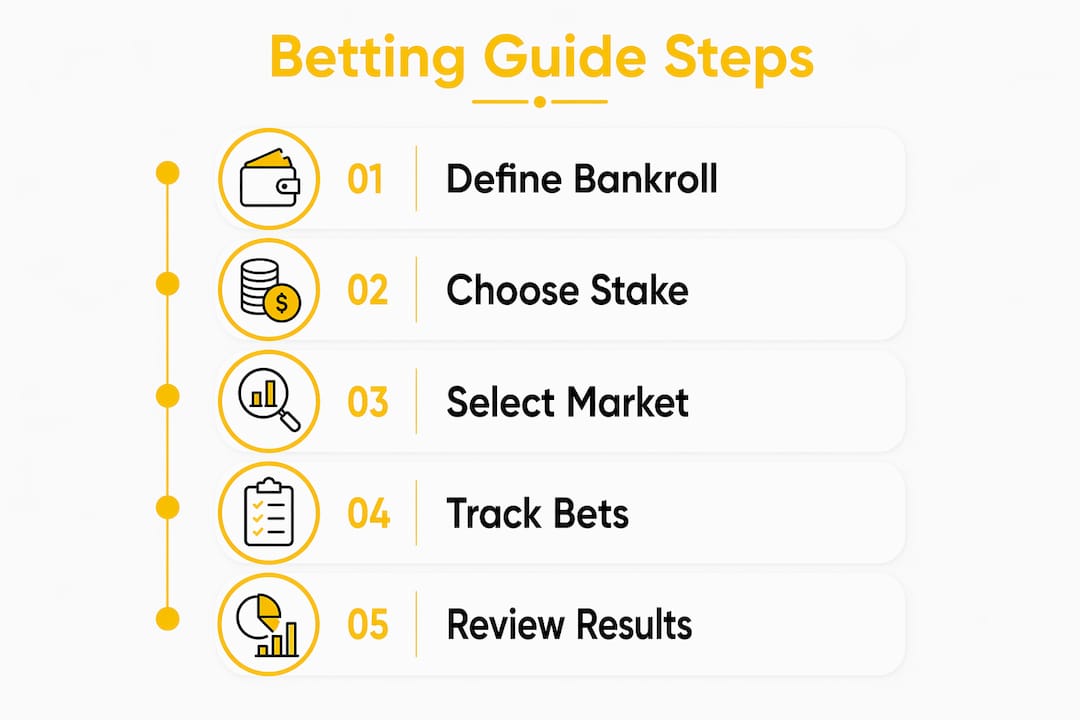
- Set up your infrastructure first. Open accounts at three or more sportsbooks to enable line shopping. Build a simple tracking spreadsheet with columns for date, sport, market, odds taken, closing odds, stake, and result. Decide your unit size as a percentage of your starting bankroll, typically 1 to 2%.
- Define your market scope. Choose one or two sports where you have genuine knowledge. Write down which bet types you will place, for example, moneylines and totals only, and which you will avoid until you have more experience.
- Practice with paper trades. Paper trading before real money bets reduces impulsive wagering and builds habits that protect your bankroll in early betting phases. Spend two to four weeks logging hypothetical bets with full reasoning before committing real money.
- Run a pre-bet checklist. Before placing any wager, confirm: Does this bet fall within my defined markets? Have I compared odds across at least three books? Is the expected value positive based on my probability estimate? Is my stake within my defined unit size?
- Audit monthly. Review your bet log at the end of each month. Calculate ROI by market and bet type. Identify any patterns where your reasoning consistently led to poor results and adjust your filters accordingly.
- Add complexity gradually. Once you are comfortable with flat staking and basic +EV identification, explore value betting strategies and matched betting to expand your profit sources without increasing risk.
Many guides fail because they jump straight to advanced mechanics before helping you choose a strategy that fits your actual bankroll and time availability. Start with the infrastructure. The strategy layers on top of it.
Key takeaways
Step-by-step betting guides work because they replace emotional decisions with fixed rules, and fixed rules produce measurable, improvable results over time.
| Point | Details |
|---|---|
| Control over prediction | A betting guide’s primary job is managing your decisions, not improving your picks. |
| Four core components | Bankroll management, odds shopping, +EV identification, and market specialization form a complete system. |
| Closing Line Value | Consistently beating the closing line yields 2 to 4% ROI and is the best measure of bet quality. |
| Responsible gambling integration | Setting deposit limits and loss thresholds before betting starts is part of the system, not optional. |
| Paper trading first | Practicing with hypothetical bets for two to four weeks builds discipline before real money is at risk. |
Why most bettors miss the point of a betting guide
I have seen a lot of bettors pick up a guide, read through the mechanics, and then go straight back to betting on instinct. The guide becomes a reference document rather than an operating system. That is the most common mistake, and it is an easy one to make.
The real shift happens when you stop treating betting as a series of individual predictions and start treating it as a repeatable process. Your edge does not come from being right more often than the bookmaker on any given game. It comes from consistently finding situations where the price is wrong and sizing your bets correctly when you do. That is an operational discipline, not a talent.
What I find most useful about structured guides is that they force you to confront your own patterns. When you log every bet with reasoning and review it monthly, you quickly discover that your “confident” bets often underperform your “value” bets. That insight alone is worth more than any single winning streak. The guide is not a guarantee of profit. It is a framework for learning what actually works for you, and that process takes time. Give it at least 200 bets before drawing any conclusions about your edge.
— Mantas
Build your betting system with Thinkbonus
If you are ready to put a structured approach into practice, Thinkbonus has the tools and guides to help you do it properly from day one.

The matched betting guide on Thinkbonus walks you through a proven, low-risk system for generating consistent profit from bookmaker promotions, with every step clearly explained for beginners. The site also offers betting calculators covering staking, odds conversion, lay stakes, and more, so you never have to do the math manually. For bettors who want structured training, the Thinkbonus Academy provides step-by-step matched betting techniques built specifically for the Canadian market. Start with the guide, use the calculators, and build your system on a solid foundation.
FAQ
What is the role of step-by-step betting guides?
Step-by-step betting guides provide a structured framework of predefined rules covering staking, market selection, and tracking, which reduces emotional decisions and improves consistent, measurable betting results over time.
How do betting guides help beginners avoid common mistakes?
Guides prevent the two most damaging beginner habits, chasing losses and overbetting after wins, by fixing stake sizes and market scope before any bet is placed.
What is Closing Line Value and why does it matter?
Closing Line Value (CLV) measures whether you bet at better odds than the market’s final price. Consistently beating the closing line is the most reliable indicator of long-term betting edge and can produce 2 to 4% ROI on its own.
How do I start using a betting guide practically?
Open accounts at multiple sportsbooks, build a tracking spreadsheet, define your unit size and market scope, then practice with paper trades for two to four weeks before placing real money bets.
Are responsible gambling tools part of a good betting guide?
Yes. Setting deposit limits, monthly loss thresholds, and scheduled breaks are core components of any disciplined betting system, not optional add-ons.