














TL;DR:
- Tax-free matched betting income in the UK is earned by exploiting bookmaker free bets and promotions without any tax liability, as HMRC classifies it as gambling winnings. It involves placing opposing bets to secure guaranteed profit, using bookmaker money rather than personal funds, and is fully legal with no tax declarations required. Starting with multiple accounts, proper tools, and disciplined account management enables bettors to earn up to £1,500 monthly without affecting personal tax or credit status.
Tax-free matched betting income in the UK is money earned by mathematically exploiting bookmaker free bets and promotional offers, classified by HMRC as gambling winnings and fully exempt from tax. Unlike freelancing or consulting, you keep every penny of profit without filing a tax return for this income. Beginners typically earn £150 to £300 in their first month from welcome offers alone, while committed matched bettors working around 10 hours per week report £500 to £1,000 monthly. Platforms like Thinkbonus and OddsMonkey provide the calculators and guides that make this process accessible to anyone willing to learn the system.
What is matched betting and why is it tax-free in the UK?
Matched betting is a risk-free technique that turns bookmaker free bets and promotions into guaranteed profit by placing two opposing bets on the same event. You back a selection to win at a bookmaker, then lay the same selection to lose at a betting exchange like Betfair. The two bets cancel out the gambling risk entirely. What remains is the value extracted from the free bet or promotion itself.
This is why the technique is mathematically structured, not a gamble. Traditional gambling involves risking your own money on an uncertain outcome. Matched betting uses bookmaker money (the free bet) to generate a profit regardless of the result. That distinction matters enormously for how HMRC views the income.
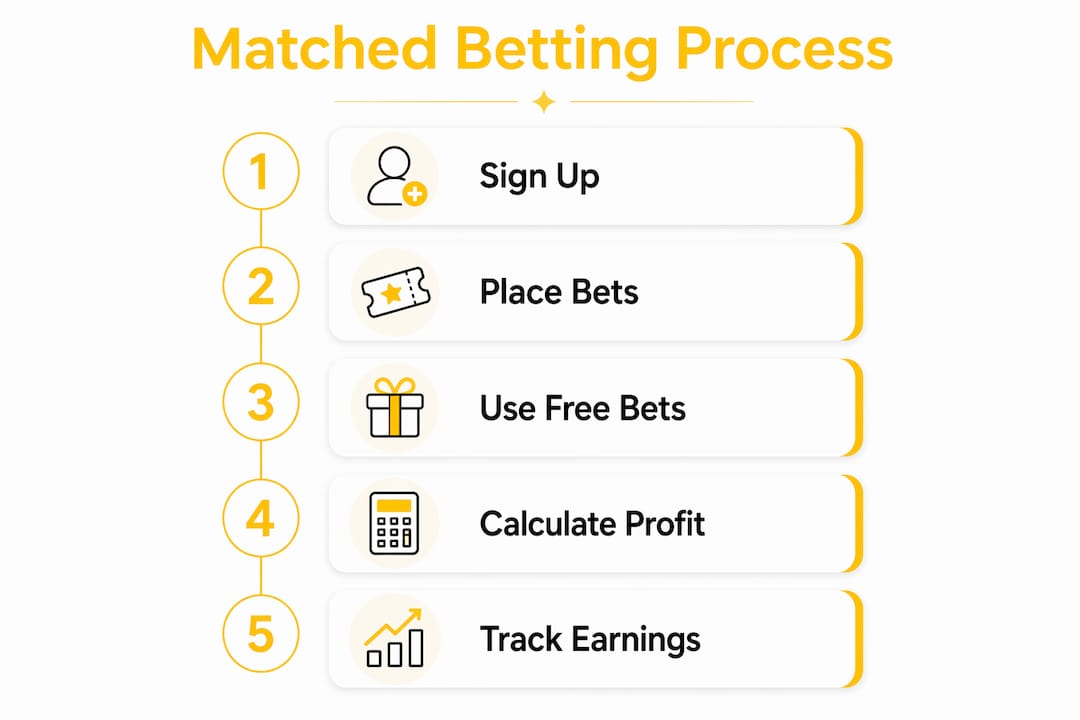
UK gambling winnings have been exempt from tax since 2001. HMRC does not require you to declare matched betting profits because they are not classified as taxable income or a trade. This is a critical point that trips up many beginners. The matched betting tax benefits here are not a loophole or gray area. They are the direct result of how UK tax law treats gambling winnings across the board.
Here is what the tax-free status means in practice:
- Matched betting profits do not appear on your self-assessment tax return
- Earnings do not count toward your personal allowance or push you into a higher tax bracket
- No HMRC declaration is required, unlike freelance or rental income
- Profits do not affect your National Insurance contributions
Pro Tip: If you also run a self-employed business or have other taxable income, keep your matched betting records completely separate. HMRC could theoretically argue that highly systematic, professional-scale matched betting constitutes a trade, though this has not been tested in UK courts for typical matched bettors.
How to get started with tax-free matched betting in the UK
Getting started requires three things: bookmaker accounts, a betting exchange account, and the right tools to calculate your bets accurately. The process is straightforward once you understand the structure.
- Open bookmaker accounts. Sign up with multiple UK-licensed bookmakers to access their welcome offers. Bet365, William Hill, Paddy Power, and Sky Bet all run new customer promotions worth exploiting. Each account gives you access to a unique welcome bonus.
- Open a Betfair Exchange account. Betfair is the most widely used betting exchange in the UK for laying bets. You need an exchange account to place the opposing lay bet that neutralizes your gambling risk.
- Use a matched betting calculator. A matched betting calculator accounts for the type of free bet you have (Stake Returned versus Stake Not Returned) and calculates the exact lay stake needed to lock in profit. This removes all manual math errors.
- Follow structured guides. The Thinkbonus matched betting guide walks you through each offer step by step, so you know exactly what to do with each promotion.
- Track every transaction. A dedicated spreadsheet recording every bet, stake, return, and profit is a recommended best practice for staying organized and auditing your own performance.
Starting bankroll and financial setup
You need a starting bankroll of roughly £200 to £500 to cover qualifying bets and lay stakes while working through welcome offers. This money is not lost. It cycles through the system and returns to you as you complete each offer.

Pro Tip: Open a dedicated bank account purely for matched betting transactions. Frequent betting activity can raise questions during mortgage or loan applications if it appears in your main account. Keeping it separate protects your financial profile and makes record-keeping much cleaner.
Here is a realistic income and time breakdown for new matched bettors:
| Experience level | Weekly time | Monthly income estimate |
|---|---|---|
| Complete beginner | 3 to 5 hours | £150 to £300 |
| Intermediate (post-welcome offers) | 5 to 10 hours | £300 to £600 |
| Serious matched bettor | 10 to 15 hours | £800 to £1,500+ |
These figures come from real matched bettor reports and reflect what is achievable with consistent effort. The income scales directly with the time and number of accounts you manage.
Strategies to maximize your matched betting profits
Welcome offers are just the starting point. The real long-term income from earning tax-free income through betting comes from reload offers, price boosts, and money-back specials that bookmakers run every week.
The transition from welcome bonuses to ongoing offers is where most matched bettors either grow or stall. Bookmakers run weekly free bet clubs, acca insurance promotions, and enhanced odds offers continuously. Thinkbonus publishes weekly free bet offers updated regularly so you never miss a profitable promotion.
Key strategies for scaling your tax-free matched betting income include:
- Reload offers. These are weekly or monthly free bets given to existing customers. They are smaller than welcome offers but add up significantly across multiple accounts.
- Price boosts. Bookmakers regularly offer enhanced odds on specific events. The price boosts page on Thinkbonus lists current opportunities worth targeting.
- Each-way offers and extra place promotions. These require slightly more calculation but deliver strong returns, especially during major horse racing events.
- Multiple account management. Compound strategies using multiple bookmaker accounts push monthly profits well beyond £1,000 for organized matched bettors.
Pro Tip: Behave like a regular bettor on each account. Place occasional small recreational bets on events you genuinely follow. Bookmakers use automated systems to flag accounts that only ever use promotions, and acting naturally extends your account lifespan considerably.
Here is a comparison of offer types by effort and return:
| Offer type | Effort level | Typical profit per offer |
|---|---|---|
| Welcome free bet | Low | £20 to £50 |
| Weekly reload offer | Low to medium | £5 to £20 |
| Price boost | Medium | £3 to £15 |
| Each-way extra place | Medium to high | £10 to £40 |
| Acca insurance | Medium | £5 to £25 |
Common pitfalls and how to avoid them
The biggest practical challenge in matched betting is account restrictions. Bookmakers use automated systems to detect and restrict accounts that exploit bonuses systematically. This is called “gubbing.” A gubbed account loses access to free bets and promotions, reducing its value significantly.
Managing account hygiene is the most important skill beyond the basic mechanics. Here is what works:
- Vary your bet sizes. Never stake exactly the minimum required for a promotion every single time. Varying amounts by small margins looks more natural.
- Use different devices and browsers. Switching between devices when accessing different bookmaker accounts helps avoid cross-account detection patterns.
- Avoid round numbers. Bookmakers notice when every single bet is exactly £10.00. Staking £9.87 or £11.23 occasionally looks more human.
- Withdraw funds gradually. Withdrawing your entire balance immediately after claiming a bonus is a red flag. Leave some funds and make a few small bets first.
Banking scrutiny is a separate but related concern. Frequent betting transactions can complicate mortgage applications if a lender reviews your bank statements. A dedicated account for matched betting solves this completely. Your main account stays clean, and your matched betting account shows the activity separately.
One more point worth addressing directly: is matched betting legal in the UK? Yes, completely. There is no law against using bookmaker promotions as intended. Bookmakers offer free bets to attract customers. Matched betting simply uses those offers more efficiently than the average recreational bettor. HMRC recognizes the income as gambling winnings, and gambling earnings do not affect your credit rating since no credit is involved.
Key takeaways
Matched betting profits are fully tax-free in the UK because HMRC classifies them as gambling winnings, not trade income, meaning you keep 100% of what you earn with no declaration required.
| Point | Details |
|---|---|
| Tax-free status confirmed | HMRC classifies matched betting profits as gambling winnings, exempt from tax since 2001. |
| Income potential is real | Beginners earn £150 to £300 monthly; serious matched bettors reach £800 to £1,500+ with 10 to 15 hours weekly. |
| Calculators are non-negotiable | Use a matched betting calculator to handle Stake Returned vs. Stake Not Returned bets accurately. |
| Account hygiene protects income | Varying bet sizes and behaving naturally delays bookmaker restrictions and preserves long-term profits. |
| Separate banking matters | A dedicated bank account keeps matched betting activity away from personal finances and mortgage applications. |
Why matched betting is the most underrated side income in the UK
I have spent years watching people dismiss matched betting as “too complicated” or “too risky,” and it genuinely frustrates me. This is not gambling. It is closer to a financial arbitrage strategy than anything you would find at a casino. The math is fixed before you place a single bet.
What I find most valuable about matched betting is not just the money. It teaches you to read odds, understand probability, and manage a small portfolio of accounts with discipline. Those are real financial skills. People pay for courses to learn less practical things.
The one honest caveat I will give you: patience matters more than intelligence here. The bettors who burn out are the ones chasing big wins or skipping the record-keeping. The ones who build steady, consistent income treat it like a part-time job with very good hourly returns. I have seen people clear £600 in a single weekend during a major football tournament by working through a stack of prepared offers methodically.
The bookmaker landscape does change. Restrictions come faster than they did five years ago, and welcome offers are slightly less generous than they once were. But reload offers, price boosts, and exchange arbitrage opportunities are still abundant for anyone who stays organized and keeps learning. The tax-free status is not going anywhere either. UK gambling law is settled on this point.
— Mantas
Start earning tax-free income with Thinkbonus
If you are ready to turn bookmaker promotions into consistent, tax-free income, Thinkbonus has everything you need in one place.
The Bonus Matched Betting Academy gives you structured, step-by-step training covering welcome offers, reload strategies, and advanced techniques for scaling your income. You get access to the full suite of Thinkbonus calculators, including the matched betting calculator that handles every offer type automatically. The new customer offers page is updated daily with the best current bookmaker promotions so you always know where to start. Whether you are placing your first qualifying bet or managing 20 accounts, Thinkbonus gives you the tools and knowledge to do it right.
FAQ
Is matched betting income tax-free in the UK?
Yes. Matched betting profits are tax-free because HMRC classifies them as gambling winnings, which have been exempt from UK tax since 2001. You do not need to declare this income on a self-assessment return.
Who pays tax on matched betting profits?
Nobody in the UK pays tax on matched betting profits. HMRC does not classify matched betting income as a trade or taxable earnings, so no income tax or National Insurance applies regardless of how much you earn.
How much can you realistically earn from matched betting?
Beginners typically earn £150 to £300 per month from welcome offers working 3 to 5 hours weekly. Committed matched bettors investing 10 to 15 hours weekly consistently reach £800 to £1,500 or more per month.
Does matched betting affect your credit score?
No. Gambling earnings do not affect credit ratings in the UK because no credit is involved. However, frequent betting transactions in your main bank account can raise questions during mortgage applications, which is why a separate dedicated account is strongly recommended.
Is matched betting legal in the UK?
Matched betting is completely legal in the UK. It uses bookmaker free bets and promotions exactly as they are intended, and no law prohibits placing opposing bets to hedge risk. HMRC’s treatment of the income as tax-free gambling winnings further confirms its legitimate status.