














TL;DR:
- A sticky bonus merges with your deposit into a single non-withdrawable balance until you fulfill the full wagering requirement. It locks your funds, making early withdrawal impossible and deducting the bonus at cashout. Non-sticky bonuses keep deposit and bonus separate, allowing withdrawal anytime with lower risk.
A sticky bonus in betting is a non-withdrawable bonus that merges with your deposit into a single locked balance, which you cannot touch until you complete the full wagering requirement. The industry also calls this a “non-cashable bonus” or “phantom bonus.” You will see it across Canadian online sportsbooks and casino platforms, often marketed as a generous deposit match. Before you accept one, you need to understand exactly what you are agreeing to, because the mechanics are very different from a standard bonus offer.
What is a sticky bonus in betting?
A sticky bonus is defined as a promotional credit that combines with your deposit into one merged balance, making the entire amount non-withdrawable until wagering conditions are fully satisfied. The bonus “sticks” to your account. You cannot separate it, spend it independently, or cash it out at any point during play.

The key phrases to watch for in terms and conditions are “for wagering only,” “non-withdrawable,” and “bonus sticks to your deposit.” These signal a sticky bonus regardless of how the offer is branded on the promotions page. Some operators call them “non-cashable bonuses” or “phantom bonuses,” but the mechanics are identical.
The practical effect is straightforward. You deposit $100, receive a 100% match bonus of $100, and your account shows $200. That $200 is locked. You play through the wagering requirement, and only then can you withdraw. The bonus itself is never yours to keep as cash. It exists purely to extend your play.
How do sticky bonuses work in practice?
Understanding the full mechanics of sticky bonus wagering protects you from surprises at the cashier. Here is how the process works from deposit to withdrawal:
- Deposit and bonus merge. Your real money deposit and the bonus credit combine into a single balance. There is no separate “bonus wallet.”
- Wagering applies to the combined total. A 35x wagering requirement on a $100 deposit plus $100 bonus means you must wager $7,000 total before withdrawing anything. That is a significant commitment.
- Early withdrawal voids everything. If you try to cash out before completing wagering, you forfeit the bonus and all winnings accumulated during play. Your deposit may also be at risk depending on the platform’s rules.
- The deduct-at-cashout mechanic applies. When you do complete wagering, the bonus amount is subtracted from your balance at withdrawal. If your balance is $250 after clearing a $100 sticky bonus, you withdraw $150. The $100 bonus disappears at the point of cashout.
- Expiry clocks are running. Most sticky bonuses carry a 7 to 30 day expiry. Fail to clear wagering in time and the bonus, along with any associated winnings, is removed.
Pro Tip: Before accepting any bonus, search the terms for the phrase “withdraw your deposit at any time.” If that phrase is absent, treat the offer as sticky until proven otherwise.
The deduct-at-cashout mechanic is the part most bettors miss. You can run your balance up to $400 during play, but if a $100 sticky bonus is attached, your actual withdrawable equity is $300. Mentally separating the bonus value from your real balance helps you make clearer decisions about when to stop playing.
What is the difference between sticky and non-sticky bonuses?
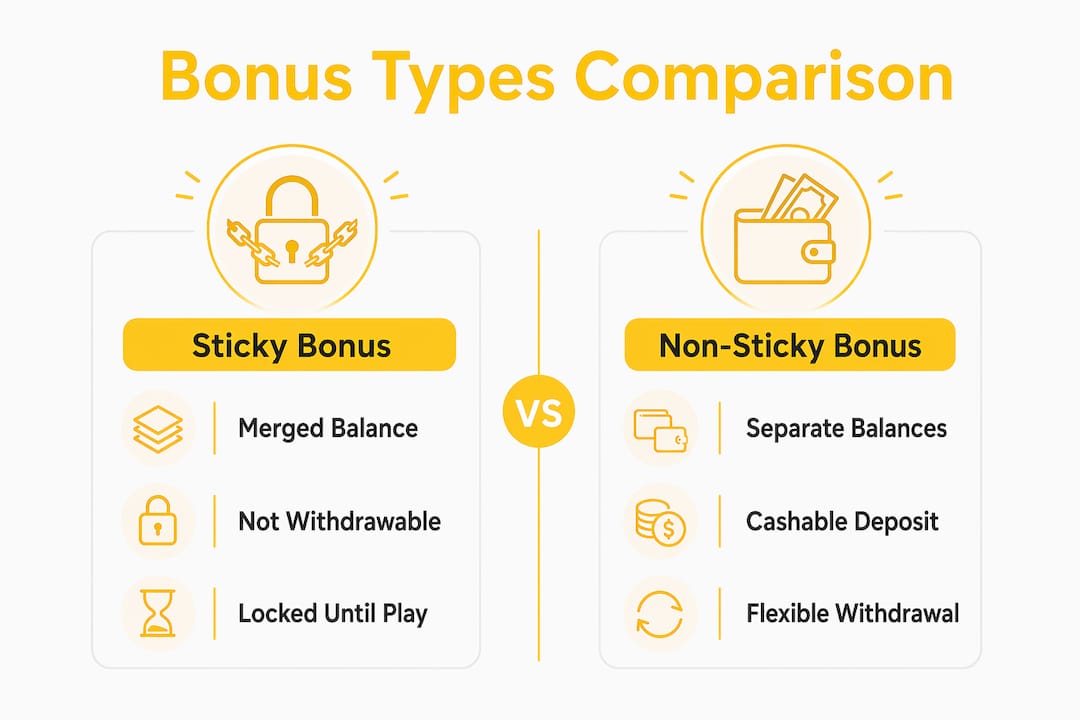
Non-sticky bonuses, also called cashable or parachute bonuses, keep your deposit and bonus in separate account balances. You can withdraw your deposit and any real-money winnings at any point, even before the bonus wagering is complete. If you withdraw early, you simply forfeit the unused bonus funds. Your own money stays safe.
The wagering math is also far more favorable with non-sticky offers. A non-sticky bonus with a 35x requirement on a $100 bonus means you wager $3,500 total. The sticky equivalent on the same deposit requires $7,000. That is twice the wagering exposure for the same headline bonus amount.
Here is a direct comparison to make the difference clear:
| Feature | Sticky bonus | Non-sticky bonus |
|---|---|---|
| Deposit accessibility | Locked until wagering complete | Withdrawable at any time |
| Wagering applies to | Deposit plus bonus combined | Bonus amount only |
| Early withdrawal penalty | Bonus and winnings forfeited | Bonus forfeited, deposit kept |
| Bonus at cashout | Deducted from balance | Kept as cash if wagering cleared |
| Risk level | Higher | Lower |
The benefits of non-sticky bonuses are clear for most bettors. Your deposit is never at risk from the bonus mechanics. You can walk away at any point with your real money intact. Non-sticky offers are generally the smarter choice, and experienced bettors actively seek them out when comparing platforms.
That said, sticky bonuses are not automatically worthless. The key variables are the wagering multiplier and the bonus size. A sticky bonus with a 5x or 10x wagering requirement on a large deposit match can still offer real value, because the total wagering demand stays manageable.
What are the risks of sticky bonuses?
Sticky bonuses are designed to favor the operator. Forcing longer wagering cycles increases the house edge exposure on your bankroll. The longer you play, the more variance works against you, and the more likely your balance drifts toward zero before you clear the requirement.
The specific risks to understand before accepting a sticky offer:
- Bankroll erosion through variance. You might run your balance up early, but extended wagering exposure means statistical variance usually pulls winnings back toward the house edge over time.
- Misleading marketing language. Some operators describe bonuses as “wagering on bonus only” while still implementing sticky behavior. The only reliable test is checking whether you can withdraw your deposit while the bonus is active. If you cannot, it is sticky.
- Max bet restrictions. Most sticky bonuses cap your bet size during wagering, often at $5 to $10 per round. Exceeding this limit can void the bonus entirely, even after you have completed most of the wagering.
- Game restrictions. Slots typically contribute 100% toward wagering, while sports bets, blackjack, and live dealer games often contribute 10% or less. This dramatically extends the real wagering demand.
- Expiry pressure. Short expiry windows push you to bet faster and larger, which increases risk and reduces your ability to be selective.
Pro Tip: Use the bonus rollover strategy framework before accepting any sticky offer. Map out the total wagering required, the daily bet volume needed to clear it before expiry, and the max bet limit. If the numbers do not work within your bankroll, decline the offer.
Sticky bonuses are worth considering only when the wagering requirement is 10x or less and the bonus amount is substantial relative to your deposit. Outside of those conditions, the risk-to-reward ratio tilts heavily toward the operator.
How can Canadian bettors get the most from sticky bonus offers?
Canadian online betting platforms, including those regulated under provincial frameworks in Ontario, frequently bundle sticky bonuses into welcome packages. Knowing how to evaluate and play them correctly makes a real difference to your bottom line.
Here is a practical approach to sticky bonus betting conditions in the Canadian market:
- Read the full terms before depositing. Look for the phrases “non-withdrawable,” “for wagering only,” or “bonus sticks to deposit.” If the terms do not explicitly say you can withdraw your deposit while the bonus is active, assume it is sticky.
- Calculate your total wagering commitment. Multiply the combined deposit and bonus by the wagering multiplier. A $200 combined balance at 30x means $6,000 in total bets. Decide if your bankroll supports that volume before the expiry date.
- Use a calculator to plan your sessions. Tools like the Thinkbonus matched betting calculator help you model wagering scenarios and identify the most efficient path through a rollover requirement.
- Stick to high-contribution games. If sports betting contributes only 10% toward wagering, a $10 bet counts as $1. Slots at 100% contribution clear requirements far faster, though they carry higher variance.
- Set a stop-loss before you start. Decide in advance the balance level at which you will stop playing, even if wagering is incomplete. Losing your entire deposit chasing a sticky bonus is the worst outcome.
- Compare offers across platforms. Canadian bettors have access to a growing number of licensed operators. A non-sticky bonus with a 40x requirement is almost always better than a sticky bonus with a 20x requirement on the same deposit amount.
The casino offer introduction at Thinkbonus walks through how to spot bonus types quickly from the terms page, which saves a lot of time when comparing multiple platforms.
Key takeaways
Sticky bonuses lock your deposit and bonus into a single non-withdrawable balance, requiring full wagering completion before any funds can be accessed, making non-sticky bonuses the better choice for most Canadian bettors.
| Point | Details |
|---|---|
| Sticky bonus definition | Deposit and bonus merge into one locked balance; neither is withdrawable until wagering is complete. |
| Wagering math matters | A sticky 35x requirement on $200 combined demands $7,000 in bets versus $3,500 for a non-sticky equivalent. |
| Deduct-at-cashout mechanic | The bonus is subtracted from your balance at withdrawal, so only net winnings above the bonus amount are yours. |
| When sticky bonuses work | Low wagering multipliers of 10x or less with large bonus amounts can make sticky offers worth accepting. |
| Best protection strategy | Always check if your deposit is withdrawable while the bonus is active. If it is not, the bonus is sticky. |
My honest read on sticky bonuses after years of watching bettors use them
I have seen a lot of Canadian bettors get burned by sticky bonuses, not because they were careless, but because the marketing is genuinely designed to obscure the mechanics. A “100% match up to $500” headline sounds identical whether the bonus is sticky or non-sticky. The difference only becomes clear three paragraphs deep in the terms and conditions, written in the smallest font on the page.
My experience is that sticky bonuses are almost never the best option when a non-sticky alternative exists on a comparable platform. The deduct-at-cashout mechanic alone changes the value proposition dramatically. You are not receiving $500 in bonus funds. You are receiving $500 in temporary wagering credit that disappears at cashout. That is a very different thing.
That said, I do not dismiss sticky bonuses entirely. I have used them profitably when the wagering requirement was genuinely low, around 5x to 8x, and the deposit match was large. In those cases, the math works out. But those offers are rare, and they require disciplined bankroll management and a clear plan before you deposit a single dollar.
The Canadian market is maturing fast. More licensed operators means more competition for your deposit, which means better bonus terms over time. My advice is to use that competition to your advantage. Seek out non-sticky offers, compare wagering requirements carefully, and never accept a sticky bonus without running the numbers first. Responsible bankroll management is not just good advice. It is the difference between a profitable bonus and an expensive lesson.
— Mantas
Make sticky bonuses work harder with Thinkbonus
Navigating sticky bonus betting conditions is much easier when you have the right tools behind you. Thinkbonus offers a full matched betting guide that walks you through how to evaluate any bonus offer, calculate your real wagering exposure, and identify the most profitable path through a rollover requirement.

The Thinkbonus matched betting calculator takes the manual math out of the equation entirely. Enter your deposit, bonus amount, and wagering multiplier, and it maps out exactly what you need to clear the requirement within your bankroll and time limits. Whether you are working through a sticky offer or a non-sticky one, having the numbers in front of you before you start is the smartest move you can make.
FAQ
What does “sticky bonus” mean in betting?
A sticky bonus is a deposit match or promotional credit that merges with your real money deposit into a single non-withdrawable balance. You cannot access any funds, including your original deposit, until the full wagering requirement is completed.
How is a non-sticky bonus different from a sticky one?
A non-sticky bonus keeps your deposit and bonus in separate balances, allowing you to withdraw your real money at any time. With a sticky bonus, your deposit is locked alongside the bonus until wagering is fully cleared.
Can you ever withdraw a sticky bonus?
No. The sticky bonus amount is deducted at cashout and cannot be withdrawn as cash. Only the net winnings above the bonus amount are available to you after wagering is complete.
Are sticky bonuses worth it for Canadian bettors?
Sticky bonuses are worth considering only when the wagering requirement is 10x or less and the bonus amount is large relative to the deposit. In most cases, a non-sticky bonus with comparable terms offers better value and lower risk.
How do I know if a bonus is sticky before I accept it?
Check the terms for the phrase “withdraw your deposit at any time.” If that phrase is absent and the terms include language like “non-withdrawable” or “for wagering only,” the bonus is sticky. Testing whether your deposit is accessible while the bonus is active is the definitive confirmation.