














TL;DR:
- Matched betting involves placing opposing bets to convert bookmaker promotions into reliable profit without relying on luck, especially through reload offers and free bet clubs. It requires disciplined tracking, understanding exchange commissions, and executing small, carefully calculated bets to build sustainable secondary income in Canada. Consistent effort, proper bankroll management, and use of tools like calculators are key to maximizing earnings through this low-risk, structured approach.
Matched betting secondary income is generated by placing two opposing bets that cover every possible outcome, converting bookmaker free bets and promotions into consistent profit without relying on luck. This process, known formally as bonus arbitrage or matched betting, uses a back bet placed with a fixed-odds sportsbook and a lay bet placed on a betting exchange like Betfair Exchange to hedge all outcomes and extract the promotional value. The math is straightforward, the risk is minimal when done correctly, and Canadians are increasingly using it as a reliable way to earn a secondary income. Tools like matched betting calculators and structured guides make the process accessible even if you have never placed a bet before.
Matched betting secondary income explained: how the core mechanics work
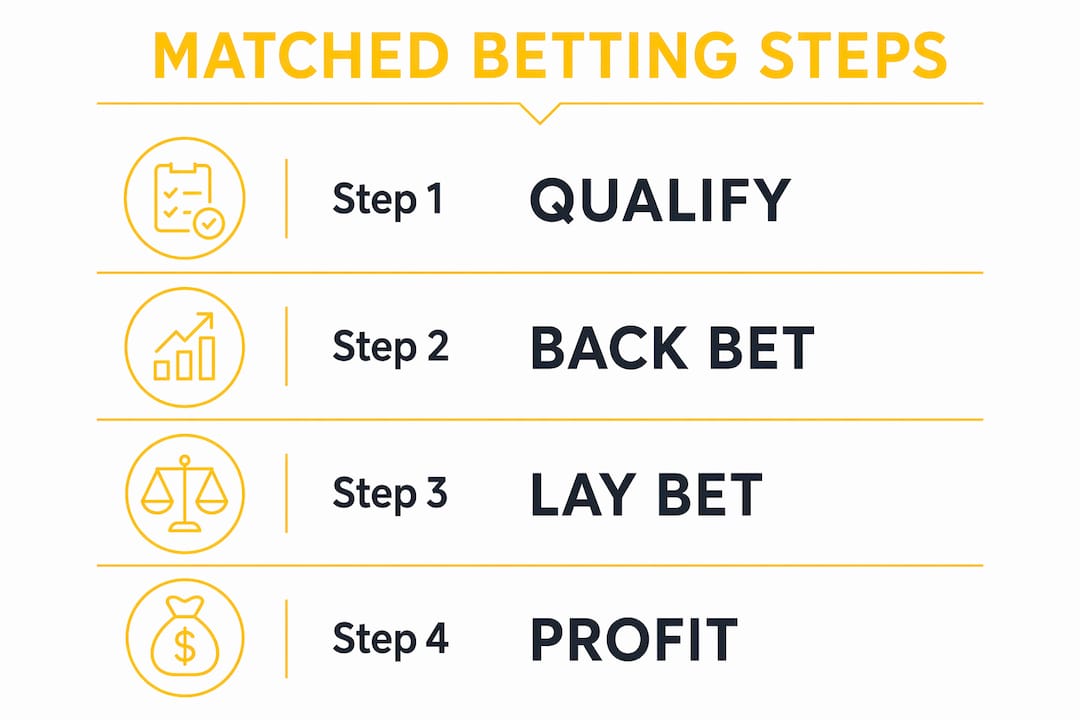
Matched betting works by placing two bets on the same event that cancel each other out, leaving only the profit from the bookmaker’s promotion. Here is the step-by-step process:
- Place a qualifying back bet at a sportsbook. This is a standard bet on a team or player to win, placed at fixed odds.
- Place a lay bet on the same selection at a betting exchange like Betfair Exchange. A lay bet means you are betting against that outcome, acting as the bookmaker.
- The two bets offset each other. Regardless of the result, you win one bet and lose the other. The small difference in odds creates a minor qualifying loss, which is the cost of unlocking the free bet.
- Receive the free bet from the sportsbook as a reward for completing the qualifying bet.
- Repeat the back and lay process using the free bet. Because the free bet stake is not returned with winnings, you extract roughly 70 to 80 percent of its face value as pure profit.
For example, if a sportsbook offers a $50 free bet after your first deposit, you place a qualifying back and lay bet to unlock it. You might lose $2 to $3 in the qualifying stage due to the odds difference. Then you use the $50 free bet, hedge it on the exchange, and walk away with roughly $35 to $40 in profit. That is a net gain of around $33 to $38 from a single promotion.
Matched betting uses mathematical hedging rather than luck, covering all outcomes to convert free bets into near-guaranteed profit. This is what separates it from gambling. You are not predicting outcomes. You are exploiting the promotional structure of the sportsbook.

Pro Tip: Timing matters. Place your back and lay bets as close together as possible to avoid odds shifting between the two. Even a small odds movement can turn a small profit into a small loss on the qualifying bet.
What role do betting exchanges and commission play in your profits?
A betting exchange is not the same as a sportsbook. A sportsbook sets the odds and takes your money when you lose. An exchange like Betfair Exchange connects bettors directly, letting you bet against other users. This is what makes lay betting possible.
The catch is commission. Betfair Exchange charges commission on net winnings, with standard customers capped at 5%. Through the My Betfair Rewards program, you can choose commission tiers of 2%, 5%, or 8%, and no commission is charged on your returned stake. That last point matters more than most beginners realize. You only pay commission when you win on the exchange, not on the full amount returned to your account.
Here is how commission affects your actual payout:
| Commission Rate | Exchange Winnings | Commission Paid | Net Payout |
|---|---|---|---|
| 2% | $90 | $1.80 | $88.20 |
| 5% | $90 | $4.50 | $85.50 |
| 8% | $90 | $7.20 | $82.80 |
The difference between 2% and 8% on a $90 win is $6.40. That gap compounds significantly over dozens of offers per month. Choosing the right commission tier is one of the most overlooked profit levers in matched betting.
Pro Tip: If you are just starting out, the 5% standard rate is fine. Once you are placing regular volume, explore the 2% tier through My Betfair Rewards. The savings add up fast over a full month of offers.
You can learn more about how the exchange works and how to navigate commission structures in the Thinkbonus Betfair Exchange guide before placing your first lay bet.
What strategies maximize matched betting as a secondary income in Canada?
The biggest mistake new matched bettors make is chasing large signup bonuses and ignoring the smaller, repeatable offers that actually build consistent monthly income. Prioritizing reload offers and free bet clubs over one-time signup bonuses is the strategy that separates disciplined earners from those who burn out after a few weeks.
Here are the core strategies that work for Canadian matched bettors:
- Focus on reload offers. Many Canadian sportsbooks offer weekly free bets, enhanced odds, and cashback promotions to existing customers. These are your bread and butter for ongoing income.
- Join free bet clubs. Some sportsbooks run structured weekly programs where you earn a free bet by placing a qualifying bet each week. This creates a predictable, repeatable income stream.
- Use a matched betting calculator. Calculators improve staking accuracy and adjust for exchange commission, so you always know your exact profit or qualifying loss before placing a bet.
- Track every bet. Keep a spreadsheet or use a dedicated tracker to log your stakes, odds, free bets received, and profits. Without tracking, you cannot spot patterns or identify which offers are worth your time.
- Manage your bankroll carefully. Start with enough funds to cover both your back and lay bets simultaneously. A common starting point is $500 to $1,000 split across your sportsbook and exchange accounts.
- Avoid gubbing. Gubbing is when a bookmaker restricts your account from receiving promotions. You reduce this risk by occasionally placing small recreational bets at normal odds, avoiding suspiciously round stakes, and not always betting the minimum qualifying amount.
Bankroll management and careful offer selection are the two factors that most directly determine whether matched betting generates sustainable income or stalls after the first few promotions.
On the legal side, Canadian bettors can use licensed sportsbooks and exchanges without concern. Licensed operators provide consumer protections including responsible gambling measures and dispute resolution processes. Stick to licensed platforms and you are operating within a safe, regulated environment.
What are the realistic earnings and time commitment for matched betting?
Matched betting is not passive income. It requires active effort to find offers, calculate stakes, place bets, and track results. That said, the time investment is modest compared to the returns.
Devoting 5 hours per week to matched betting can realistically earn between $10 and $30 per hour, depending on your experience and access to offers. Earnings vary because more experienced bettors spot better offers faster and make fewer qualifying errors.
| Experience Level | Weekly Hours | Estimated Monthly Profit |
|---|---|---|
| Beginner | 5 hours | $150 to $250 |
| Intermediate | 8 hours | $300 to $500 |
| Advanced | 10+ hours | $500+ |
Consistent activity with repeatable offers can generate $300 to $500 per month for disciplined intermediate bettors. That figure assumes you are working through reload offers and free bet clubs regularly, not just signup bonuses.
A practical weekly schedule looks like this: spend 30 minutes on Monday reviewing available offers for the week, 20 minutes each on Wednesday and Friday placing qualifying bets, and 30 minutes on the weekend converting free bets and logging results. That is roughly 2 to 3 hours of focused work producing meaningful returns.
Pro Tip: Do not try to do everything at once when you are starting out. Pick two or three sportsbook offers per week, execute them cleanly, and build your confidence before scaling up. Rushing leads to staking errors that eat into your profit.
The Thinkbonus guide on matched betting earnings breaks down profit expectations in more detail, including how bonus size and commission rates affect your monthly take-home.
Key takeaways
Matched betting generates consistent secondary income by hedging bookmaker promotions through back and lay bets, with profit determined by offer quality, exchange commission, and disciplined execution.
| Point | Details |
|---|---|
| Core mechanic | Place opposing back and lay bets to cover all outcomes and extract free bet value as profit. |
| Commission impact | Betfair Exchange commission tiers range from 2% to 8%; choosing the right tier directly affects monthly earnings. |
| Income potential | Intermediate bettors devoting 8 hours per week can realistically earn $300 to $500 per month. |
| Sustainable strategy | Reload offers and free bet clubs provide repeatable income; signup bonuses alone are not a long-term plan. |
| Risk control | Bankroll tracking, calculator use, and avoiding gubbing are the three pillars of long-term matched betting success. |
My take after years of watching matched bettors succeed and fail
The people who make matched betting work long-term are not the ones chasing the biggest bonuses. They are the ones who treat it like a part-time job with a system. They track every bet, they know their commission rate, and they never place a bet without running the numbers first.
The most common mistake I see from beginners is skipping the calculator and eyeballing the lay stake. That single habit costs people real money. A $5 error on a lay stake might seem small, but multiply that across 20 offers a month and you have wiped out a week’s worth of profit.
I also think the Canadian market is genuinely underutilized right now. The sportsbook landscape here has expanded significantly, and with more licensed operators comes more promotions. That means more offers to work through, more reload bonuses, and more free bet clubs. The window for building a meaningful secondary income through matched betting is wide open for anyone willing to put in the time to learn the system properly.
The one thing I would caution against is treating matched betting as completely effortless. It is low risk when done correctly. But “low risk” is not the same as “no effort.” The discipline of tracking, calculating, and staying organized is what separates the people earning $400 a month from the ones who gave up after two weeks.
Start small, stay consistent, and use every tool available to you. The math is on your side.
— Mantas
Start building your matched betting income with Thinkbonus
If you are ready to put this into practice, Thinkbonus has everything you need in one place.
The Bonus Matched Betting Academy walks you through the entire process step by step, from placing your first qualifying bet to working through advanced reload strategies. It is built specifically for beginners and intermediates who want a structured path to consistent profit. Alongside the Academy, the Thinkbonus matched betting guide covers core concepts in plain language, and the weekly free bet club offers page keeps you updated on the best recurring promotions available to Canadian bettors. You do not need to figure this out alone.
FAQ
What is matched betting and how does it generate income?
Matched betting places a back bet at a sportsbook and a lay bet on a betting exchange to cover all outcomes, extracting profit from free bets and promotions rather than relying on a win.
Is matched betting legal in Canada?
Yes. Matched betting uses licensed sportsbooks and exchanges, and individual bettors are not committing any offense by placing bets with licensed operators that offer consumer protections.
How much can a beginner realistically earn from matched betting?
Beginners devoting around 5 hours per week can earn between $150 and $250 per month, with earnings increasing as experience and offer volume grow.
What is a lay bet and why does it matter?
A lay bet is a wager placed on a betting exchange where you bet against a specific outcome, acting as the bookmaker. It is the second half of every matched bet and is what eliminates outcome risk.
Do I need a large bankroll to start matched betting?
A starting bankroll of $500 to $1,000 split across a sportsbook and a betting exchange account is enough to begin working through offers while maintaining enough float to cover both sides of each bet.