














TL;DR:
- A back bet is a wager that a specific outcome will occur, while a lay bet is a wager against that outcome. Back bets are placed at traditional sportsbooks, whereas lay bets are made exclusively on betting exchanges where users act as bookmakers. Understanding both types is essential for advanced betting strategies like matched betting and trading.
A back bet is a wager that a specific outcome will happen, while a lay bet is a wager that it will not happen. That single distinction defines the back vs lay bet difference and shapes everything from how you calculate risk to which platform you use. Back bets are placed at traditional sportsbooks like BetMGM or Sports Interaction. Lay bets are placed exclusively on betting exchanges like Betfair, Smarkets, or Matchbook, where you take on the role of the bookmaker. Understanding both bet types is the foundation of matched betting and serious sports betting strategy.
How do back bets work?
A back bet is the standard wager most Canadians are familiar with. You pick an outcome, place your stake, and if that outcome happens, you win. Your risk is always limited to the amount you put in.
The payout formula is straightforward: Payout = Stake × (Odds – 1) + Stake returned. So if you back the Toronto Maple Leafs to win an NHL game at odds of 2.50 with a $20 stake, you win $30 in profit plus your $20 back, for a total return of $50. If they lose, you lose only your $20 stake. Nothing more.
Back bets are available at every traditional sportsbook in Canada, including BetMGM, FanDuel, and DraftKings. You can also place back bets on betting exchanges like Betfair, where exchange odds are often 5–15% better than traditional bookmakers for shorter-priced selections. That difference adds up over time.
Common markets for back bets in Canada include:
- NHL moneylines and puck lines
- CFL game winners and point spreads
- NBA and MLB match results
- Horse racing win markets
Pro Tip: When backing on an exchange like Betfair, compare the available odds to your sportsbook before placing. You will often find better value on the exchange, especially for popular NHL games with high liquidity.
What is lay betting and how does it differ?
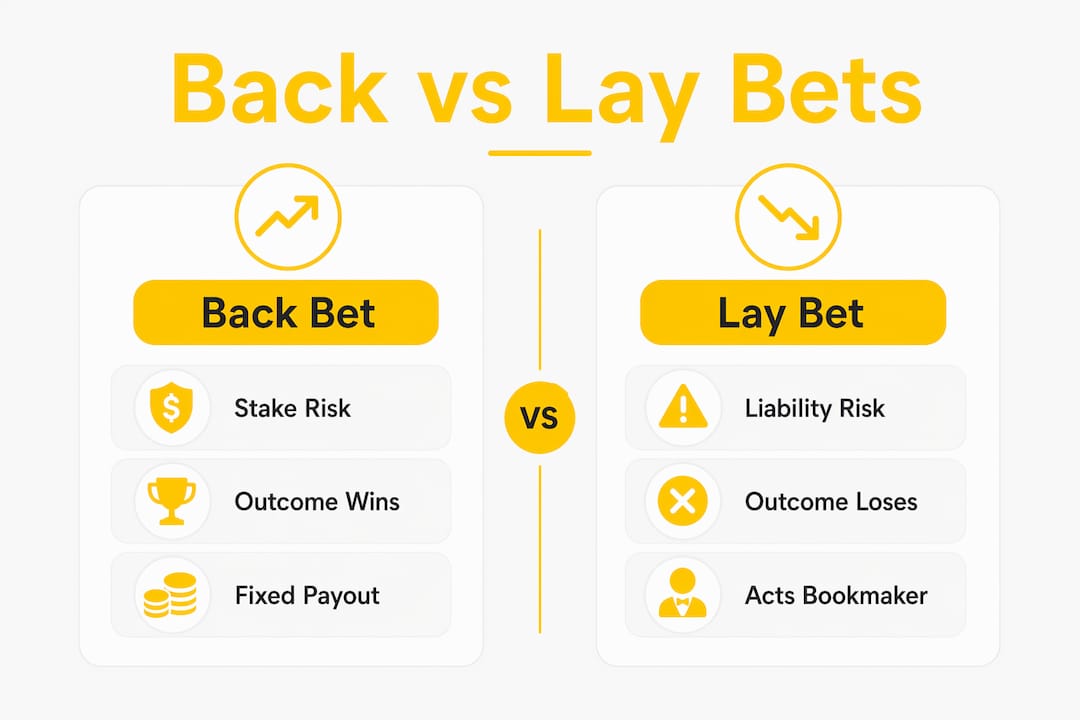
Lay betting is defined as wagering against a specific outcome occurring. When you lay a bet, you act as the bookmaker. Another bettor backs the outcome, and you agree to pay out their winnings if it happens. If the outcome does not happen, you collect their stake as profit.

Lay bets can only be placed on betting exchanges like Betfair, Smarkets, and Matchbook. These platforms match backers with layers peer to peer and charge a commission of 2–5% on net winnings instead of building a margin into the odds. That commission is a key cost to factor into every lay bet you place.
The critical number to understand is your liability. The lay bet liability formula is: (Lay Odds – 1) × Backer’s Stake. Here is a concrete example. Say you lay the Calgary Flames to win a CFL game at odds of 3.00, and the backer stakes $50. Your liability is (3.00 – 1) × $50 = $100. If the Flames win, you pay out $100. If they do not win, you collect the backer’s $50 stake as profit.
That asymmetry is what makes lay betting fundamentally different from back betting. Your potential loss can be much larger than your potential gain. Lay liability can exceed your initial stake significantly, which is why beginners often underestimate the risk.
Key facts about lay betting to keep in mind:
- You must have enough funds in your exchange account to cover the full liability before the bet is accepted.
- Exchanges enforce minimum bet requirements, which affects how you plan your bankroll.
- Commission is charged on net winnings, so factor it into your profit calculations.
- Liquidity varies by market. Popular NHL games have more available lay positions than niche markets.
Pro Tip: Always check your available balance against your calculated liability before placing a lay bet. Betfair will not accept the bet if your balance is too low, but it is better to know this before you try to place it.
Back bet vs lay bet: risk, payout, and platform comparison
The clearest way to understand the difference between back and lay is to put them side by side. The two bet types serve opposite market roles and carry very different risk profiles.
| Feature | Back Bet | Lay Bet |
|---|---|---|
| What you bet on | Outcome to happen | Outcome NOT to happen |
| Your role | Bettor | Bookmaker |
| Risk | Limited to your stake | Can exceed your stake (liability) |
| Platforms | Sportsbooks and exchanges | Betting exchanges only |
| Profit if correct | Stake × (Odds – 1) | Backer’s stake (minus commission) |
| Commission | None at sportsbooks | 2–5% on exchange winnings |
| Best used for | Picking winners | Matched betting, hedging, trading |
Back bets suit bettors who want to pick a winner and accept a fixed risk. Lay bets suit bettors who want to cover outcomes, hedge positions, or act as the market maker. Neither is inherently better. They serve different purposes.
One underappreciated advantage of exchanges is odds quality. Exchange back bets often carry implied probabilities of around 100–102%, compared to 106–112% at traditional bookmakers. That means less value is lost to the house on every bet. Experienced exchange users view backing as taking a position on an outcome, while laying is providing liquidity and acting as the bookmaker, which highlights the two distinct market roles at play.
Canadian bettors can access Betfair, Smarkets, and Matchbook for both back and lay positions. Each exchange has its own commission structure and liquidity levels, so it is worth comparing before committing to one platform for your lay betting activity.
How to combine back and lay bets for profit
The real power of understanding both bet types comes when you use them together. Matched betting is the most well-known strategy that does exactly this. It works by placing a back bet at a sportsbook and a lay bet on the same outcome at a betting exchange, covering all possible results and locking in a profit from a free bet or promotion.
Here is how the process works step by step:
- Find a bookmaker promotion. A Canadian sportsbook offers a $50 free bet on your first deposit.
- Place a qualifying back bet. Back a team to win using your own money to unlock the free bet.
- Lay the same outcome on an exchange. Cover the opposite result so you break even regardless of the outcome.
- Receive the free bet. Use it to back an outcome at the sportsbook.
- Lay the same selection on the exchange. This time, the free bet stake is not returned, so you size the lay bet to extract the maximum profit from the free bet value.
- Collect your profit. You have covered all outcomes and extracted the value of the free bet with minimal risk.
Beyond matched betting, professional bettors use trading techniques that involve placing back and lay bets at different odds before an event finishes. If odds shift in your favor after you back a team, you can lay the same team at lower odds to lock in a guaranteed profit regardless of the result. This is called trading out a position.
Managing your lay stake correctly is where most beginners struggle. A lay stake calculator removes the guesswork by computing the exact lay stake needed to balance your back and lay positions, accounting for exchange commission. For more complex scenarios, a sequential lay calculator helps you manage liability across multiple lay bets in sequence.
Pro Tip: Always calculate your lay stake before placing either bet. Placing the back bet first without knowing your lay stake can leave you exposed if the odds move before you complete the lay side.
Key takeaways
The back vs lay bet difference comes down to one core principle: backing bets on outcomes happening carries limited risk, while laying bets against outcomes happening puts you in the bookmaker’s seat with potentially larger liability.
| Point | Details |
|---|---|
| Back bet risk is capped | You lose only your stake if the outcome does not happen. |
| Lay bet liability can be large | Liability equals (Lay Odds – 1) × Backer’s Stake, which can exceed your stake. |
| Lay bets need exchanges | Betfair, Smarkets, and Matchbook are the platforms for lay betting in Canada. |
| Commission affects profit | Exchanges charge 2–5% on winnings, so factor this into every lay calculation. |
| Both bets together unlock strategy | Matched betting and trading use back and lay positions to cover outcomes and profit from promotions. |
My honest take on learning the back vs lay difference
When I first started on Betfair, I understood the concept of lay betting in theory. In practice, I underestimated liability almost every time. I remember laying a horse at odds of 6.00 with what felt like a small backer’s stake, only to realize my liability was five times what I stood to gain. That is not a comfortable position to be in, especially as a beginner.
The thing most guides do not tell you is that lay betting does not feel like betting against something. It feels like running a small insurance business. You collect premiums (backer stakes) most of the time, but occasionally you pay out a claim (the backer wins). The math works in your favor when you are disciplined, but one careless lay at high odds can wipe out a week of careful work.
My advice for Canadian bettors getting started is this: do not place a single lay bet without first calculating your liability and confirming your exchange balance covers it. Use a calculator every time, not just when the numbers feel uncertain. The Betfair exchange guide on Thinkbonus walks through this process clearly, and it is worth reading before your first lay bet.
Once you genuinely understand both sides of the market, matched betting becomes far less intimidating. You stop seeing it as gambling and start seeing it as simple math applied consistently. That shift in perspective is what separates bettors who make consistent profit from those who give up after a confusing first week.
— Mantas
Start applying this knowledge with Thinkbonus
Understanding the difference between back and lay bets is the first step. Putting it into practice with the right tools is what generates real, consistent profit from Canadian bookmaker promotions.

Thinkbonus offers a full matched betting academy built for Canadian bettors, covering everything from your first qualifying bet to advanced exchange strategies. The platform includes a matched betting calculator that handles all the lay stake math automatically, so you never have to guess your liability or commission impact. Whether you are just learning how to back and lay bets or ready to scale your profits with promotions, Thinkbonus has the step-by-step guides and tools to get you there with confidence.
FAQ
What is the main difference between a back and lay bet?
A back bet wagers that an outcome will happen, with risk limited to your stake. A lay bet wagers against that outcome, putting you in the bookmaker’s role with a liability calculated as (Lay Odds – 1) × Backer’s Stake.
Where can i place lay bets in canada?
Lay bets are only available on betting exchanges. Betfair, Smarkets, and Matchbook are all accessible to Canadian bettors and support both back and lay positions.
How do i calculate my lay bet liability?
Multiply the backer’s stake by (Lay Odds – 1). For example, laying at odds of 4.00 against a $30 backer stake gives you a liability of (4.00 – 1) × $30 = $90.
What is matched betting and how does it use back and lay bets?
Matched betting uses a back bet at a sportsbook and a lay bet on the same outcome at an exchange to cover all results. This method extracts the value of free bets and promotions with minimal risk.
Do betting exchanges charge fees on lay bets?
Yes. Exchanges like Betfair and Smarkets charge a commission of 2–5% on net winnings. This applies to both back and lay bets placed on the exchange and must be factored into your profit calculations.