














TL;DR:
- Line movement betting involves analyzing shifts in betting lines caused by sharp professional action, public money, and new information. Recognizing reverse line movement and steam moves helps bettors identify smart betting opportunities driven by sharp money. Sportsbooks adjust lines to balance risk and exposure, making timely, informed bets essential for success.
Line movement betting is defined as the shift in a point spread, moneyline, or total caused by incoming wagers, sharp professional action, or new game-related information. When Baltimore opens at -7 and moves to -8 before kickoff, that single point tells a story about where the money is going. Understanding that story is one of the most practical skills a sports bettor can develop. It separates bettors who react to lines from those who actually read them.
What is line movement betting and what causes it?

Sportsbooks move lines primarily to manage risk and balance liability when one side receives disproportionate action. That is the most common driver, and it happens on nearly every game. Think of it as simple supply and demand. If too many bettors are backing the favorite, the book adjusts the spread to make the underdog more attractive.
Beyond volume, four main forces drive betting line changes:
- Public money (square action): High-volume casual bets on popular teams push lines toward favorites and overs. This is the most frequent cause of movement.
- Sharp money (professional bettors): A single large wager from a respected syndicate can move a line faster than thousands of casual tickets. Sportsbooks respect sharp bettors and adjust lines promptly to reduce liability from professional wagers more than casual public bets.
- New information: Injury reports, lineup changes, and weather updates all shift the probability of an outcome. A starting quarterback ruled out an hour before game time will move a spread by several points almost instantly.
- Cross-market signaling: When a market-maker sportsbook like Pinnacle moves a line, follower books copy the adjustment within minutes to stay aligned with the market consensus.
Pro Tip: Always check whether a line moved before or after a major injury announcement. A move before the news is far more significant than one that follows a public report.
How do you read reverse line movement and steam moves?
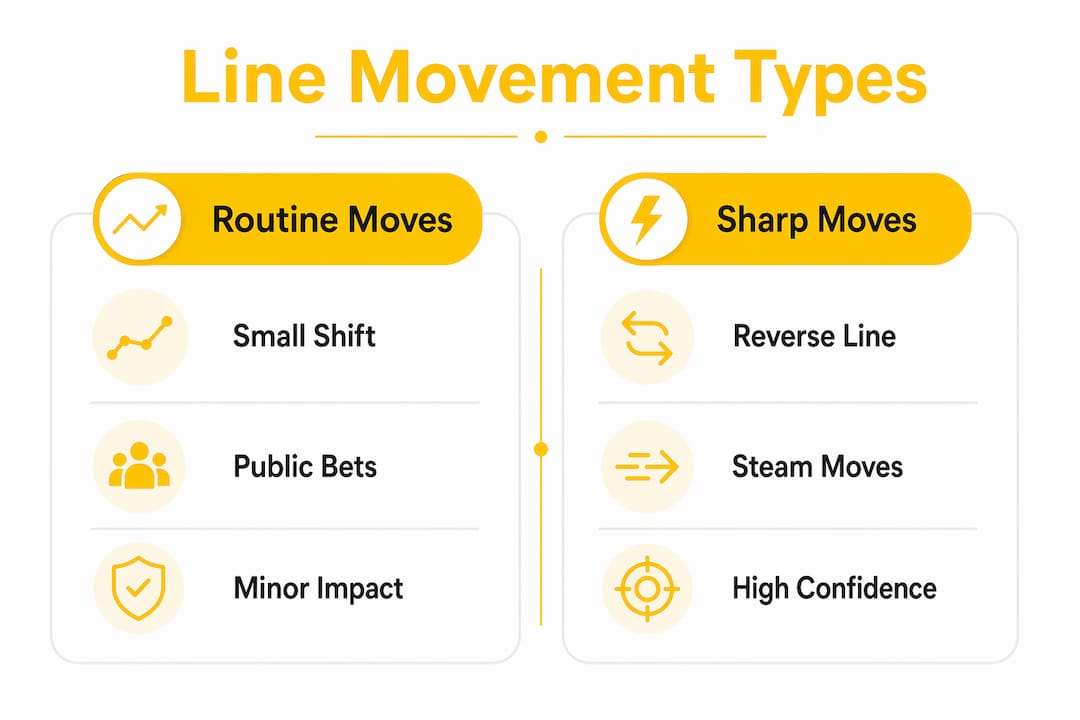
Not every line shift carries the same weight. Learning to distinguish between routine adjustments and high-signal moves is where understanding line movement gets genuinely useful.
Reverse line movement (RLM)
Reverse line movement occurs when the line moves opposite to where the majority of public bets are placed, indicating sharp professional action. Picture a scenario where 75% of betting tickets are on Team A, yet the spread moves in favor of Team B. That is RLM in action. The book is not responding to ticket volume. It is responding to the dollar volume coming from sharp accounts. RLM is widely considered one of the clearest signals that professional money disagrees with public opinion.
Steam moves
A steam move is a rapid, synchronized line shift across 10–20 sportsbooks within about 10 minutes, typically reflecting large syndicate bets. An NBA spread moving a full point or an NHL puck line shifting 0.5 points across multiple books simultaneously is a classic steam move. These moves happen because syndicates place coordinated bets across many sportsbooks at once to maximize their position before the market corrects. Catching a steam move early gives you a brief window to bet the same side before the line fully adjusts.
Routine moves vs. high-confidence moves
Here is a simple comparison to keep in mind:
| Move Type | Size | Likely Cause | Bettor Signal |
|---|---|---|---|
| Routine adjustment | 0.5 points | Public volume balancing | Low significance |
| Key number move | 1 point on NFL spread | Risk management near 3 or 7 | Moderate significance |
| High-confidence move | 1.5+ points, no injury news | Sharp or syndicate money | High significance |
| Steam move | Rapid multi-book shift | Coordinated syndicate action | Act quickly or follow |
Larger moves of 1.5+ points without any injury news are often sharp money indicators, while smaller routine half-point moves are usually just risk-balancing. That distinction alone will save you from chasing meaningless line noise.
Pro Tip: Cross-reference the line move with public betting percentages. If 70% of tickets are on one side but the line moves the other way, you have a textbook RLM signal worth investigating.
How do sportsbooks manage line movement?
Sportsbooks function as risk managers first and foremost. Their goal is not to predict winners. Their goal is to balance their exposure so they collect the vig (also called juice) regardless of the outcome.
Here is how that process works step by step:
- Opening line is set. The book uses internal models, early sharp action, and market positioning to establish the initial spread. Opening lines are less efficient than closing lines, which reflect full market consensus. That inefficiency is exactly where sharp bettors look for value.
- Action comes in. As bets are placed, the book monitors which side is attracting more money. Ticket count and dollar volume are tracked separately, since a single sharp bet can outweigh hundreds of casual tickets.
- Line adjusts like a seesaw. Sportsbooks act like a seesaw, adjusting lines to balance bets by attracting opposite-side bettors and managing financial exposure. If too much money sits on the favorite, the spread grows to make the underdog more appealing.
- Vig adjustments vs. spread moves. Books sometimes adjust the juice on a moneyline rather than moving the spread itself. Moving a team from -110 to -115 is a softer adjustment that keeps the spread intact while discouraging further action on that side.
- Line freezes occur. Line freezes happen when sportsbooks pause the market due to uncertain information or to avoid sharp bettors exploiting vulnerable lines. If an injury rumor surfaces but is not confirmed, a book may pull the market entirely until clarity arrives. This protects the book from informed bettors acting on news the public does not yet have.
Understanding this process helps you see the market as a living, reactive system rather than a static number on a screen.
How can you use line movement strategies to bet smarter?
Tracking line movement is not just academic. You can build real betting habits around it. Here are the most practical ways to apply line movement analysis to your wagers.
Track the opening line. The opening line is your baseline. Every shift from that point tells you something about market sentiment. Early line moves are usually a reflection of sharp action, while late moves tend to involve public money and smaller adjustments. Betting early on a side that sharp money has already moved gives you a worse number. Waiting for public money to inflate a line can give you a better price on the sharp side.
Use RLM to spot sharp money. When public betting percentages combined with line shift direction point in opposite directions, that is your clearest signal. You do not need to know which syndicate placed the bet. You just need to recognize that the market is telling you something the public is ignoring.
Act fast on steam moves. Steam moves close within minutes. If you spot a rapid multi-book shift, you have a narrow window to bet the same direction before the line settles at its new level. This requires having accounts at multiple sportsbooks and checking lines regularly. Canadian bettors using platforms like BetMGM, FanDuel, or PointsBet Canada can compare lines across books to catch these windows. Using a betting odds converter helps you quickly translate line changes into payout impact.
Time your bets deliberately. Sharp bettors aim to bet early on opening lines to capitalize on value before the market adjusts. If you agree with the sharp side, bet early. If you want to fade the public, wait for the line to inflate in the public’s favor and then take the other side at a better number.
Combine line movement with other signals. Line movement is a powerful filter, not a standalone system. Pair it with injury reports, weather data, and historical matchup trends to build a fuller picture before placing your bet.
Key takeaways
Line movement betting is most valuable when you can distinguish sharp money signals like reverse line movement and steam moves from routine public-driven adjustments.
| Point | Details |
|---|---|
| Core definition | Line movement is the shift in spreads or totals driven by money flow and new information. |
| Reverse line movement | When lines move against public ticket percentages, sharp professional money is likely responsible. |
| Steam moves | Rapid multi-book shifts within 10 minutes signal coordinated syndicate action worth following quickly. |
| Sportsbook behavior | Books adjust lines like a seesaw to balance exposure, not to predict winners. |
| Timing matters | Early moves reflect sharp action; late moves reflect public money inflating popular sides. |
Why most bettors misread line movement
I have watched a lot of bettors make the same mistake: they see a line move and assume it confirms their pick. If they already like the favorite and the spread grows, they take it as validation. That is backwards thinking. A line moving toward the favorite usually means the public is piling on, which is often the least reliable signal you can follow.
The moves worth paying attention to are the uncomfortable ones. When 70% of tickets are on one team and the line moves the other way, most bettors ignore it because it contradicts what feels obvious. That discomfort is exactly where the value tends to live.
For Canadian bettors specifically, the practical challenge is access to good data. Not every platform shows public betting percentages. I recommend cross-referencing lines across at least two or three books before placing a bet. The difference between a -7 and a -7.5 on an NFL spread is not trivial, especially near key numbers like 7. Understanding how betting odds work at a mechanical level makes these comparisons much faster and more intuitive.
Line movement is one piece of a larger puzzle. It works best when you combine it with injury news, situational angles, and a clear understanding of your own betting goals. Treat it as a signal, not a guarantee.
— Mantas
Take your betting further with Thinkbonus
If reading line movement has sparked your interest in betting smarter, Thinkbonus has the tools and guides to help you build on that foundation. The Matched Betting Academy walks you through everything from basic concepts to advanced techniques, including how to use bookmaker promotions to lock in consistent returns regardless of the outcome.

Canadian bettors can also explore the matched betting guide to see how combining line movement awareness with free bet offers and deposit bonuses creates real earning potential. When you understand both the market and the promotions available to you, you are working with a genuine edge. Thinkbonus makes that process straightforward, step by step.
FAQ
What is line movement in sports betting?
Line movement in sports betting is the change in a point spread, moneyline, or total from its opening value to its current or closing value. These shifts are caused by incoming bets, sharp professional action, or new information like injuries.
What does reverse line movement mean?
Reverse line movement means the betting line moves in the opposite direction of where most public tickets are placed. This signals that sharp or professional money is backing the other side with enough force to override the public volume.
How does a steam move differ from normal line movement?
A steam move is a rapid, synchronized shift across 10–20 sportsbooks within roughly 10 minutes, caused by coordinated syndicate betting. Normal line movement is gradual and driven by routine public volume or single-book adjustments.
Should you bet with or against line movement?
Betting with sharp-driven movement, especially reverse line movement or steam moves, tends to be more reliable than following public-driven shifts. Early moves aligned with sharp action carry more information than late moves inflated by casual bettors.
Why do sportsbooks freeze lines?
Sportsbooks freeze lines when uncertain information, such as an unconfirmed injury, creates risk of exploitation by informed bettors. The book pauses the market until it has enough clarity to set a fair number again.