














TL;DR:
- Bookmakers embed a built-in margin called the vig into odds, ensuring profit regardless of the outcome. Parlay bets generate disproportionately higher revenue due to compounded margins, making them major income drivers. Understanding the bookmaker’s profit strategies allows bettors to identify value and use promotions to their advantage profitably.
Bookmaker offers generate income by embedding a mathematical margin called the “vig” or “overround” directly into every set of odds, then using promotions to attract and retain the recreational bettors who fund that margin long-term. This built-in edge means bookmakers profit regardless of which side wins a bet. Understanding this mechanism is not just academic. It is the foundation for any Canadian bettor who wants to make smarter decisions and squeeze real value from the promotions on offer.
How bookmaker offers generate income through odds and margins
The vig, also called the juice or overround, is the difference between the true probability of an outcome and the odds a bookmaker actually offers. Think of a coin toss. The true probability of heads is 50%, which should translate to odds of 2.00 (even money). A bookmaker prices both heads and tails at 1.91 instead. That gap is the margin, and it is how bookmakers make money on every single market they post.
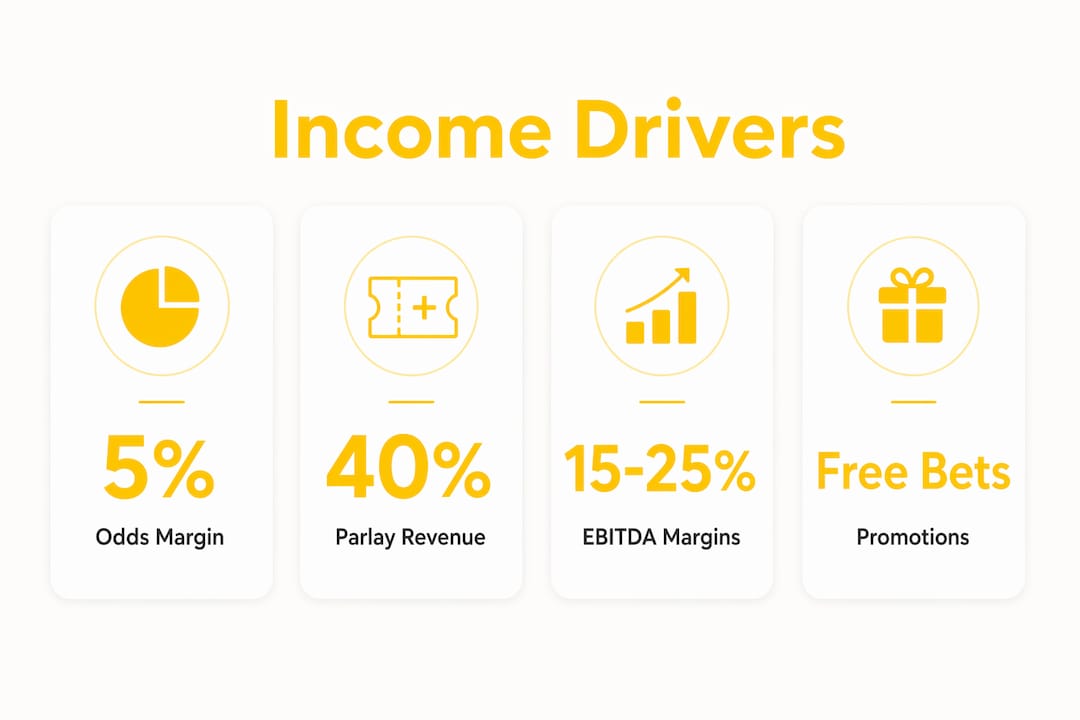
When you add up the implied probabilities from a bookmaker’s odds on any event, the total exceeds 100%. That excess is the overround. On a standard two-way market, the vig generates roughly 4.5 to 5% margin on balanced action. That means for every $100 wagered across both sides, the bookmaker keeps around $4.50 to $5.00 as profit before any other costs.
Here is a simple example to make this concrete:
- True odds (no margin): Team A wins at 2.00, Team B wins at 2.00
- Bookmaker odds (with vig): Team A at 1.91, Team B at 1.91
- Implied probability total: 52.4% + 52.4% = 104.8% (overround of 4.8%)
That 4.8% overround is the bookmaker’s built-in profit. You can explore how this works across different formats using the odds converter tool at Thinkbonus.
The practical consequence for bettors is significant. With 5% juice, a bettor needs to win approximately 52.6% of bets just to break even. Most recreational bettors win far less than that, which is exactly how bookmakers generate consistent revenue over time.
Pro Tip: Use the betting odds explained guide at Thinkbonus to calculate the overround on any market before you place a bet. Knowing the margin tells you how much of an edge you are fighting against.
Why parlays and same-game parlays are the biggest income drivers
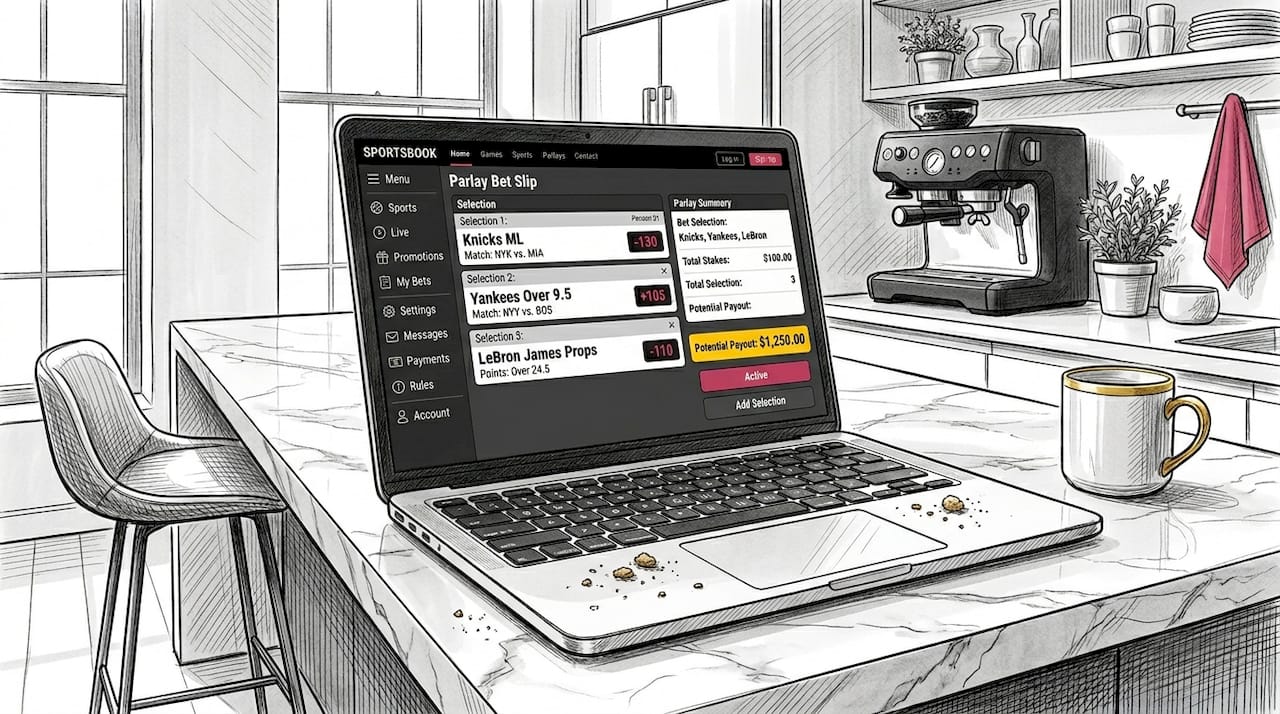
Parlays are bets that combine two or more selections into a single wager, where all selections must win for the bet to pay out. Same-game parlays (SGPs) link multiple outcomes from a single game, like a player scoring and their team winning. Both product types carry dramatically higher hold percentages than standard single bets.
Here is a direct comparison of hold percentages across bet types:
| Bet type | Typical hold percentage |
|---|---|
| Standard single bet | 4% to 8% |
| Two-leg parlay | 10% to 15% |
| Three-leg parlay | 15% to 25% |
| Same-game parlay (SGP) | 20% to 35% |
Parlays account for 40% of sportsbook revenue while representing only 22% of total betting handle. That ratio tells you everything. Bookmakers earn nearly twice as much per dollar wagered on parlays compared to straight bets. The compounded margin across multiple legs is the reason. Each leg carries its own vig, and those margins multiply together rather than simply adding up.
SGPs carry the highest margins of all because the correlated outcomes within a single game are difficult for bettors to price accurately. Bookmakers use proprietary models to set SGP odds, and the complexity makes it nearly impossible for a recreational bettor to identify value. You can use the parlay calculator at Thinkbonus to see exactly how compounded margins affect your expected return on any multi-leg bet.
Bookmakers actively promote parlays through advertising, boosted parlay odds, and “parlay insurance” offers. These promotions get people engaged with the higher-margin product, which is a deliberate bookmaker profit strategy rather than a genuine gift to bettors.
Pro Tip: If you enjoy parlays, use the double bet calculator to compare your expected return against placing two separate single bets. The difference in expected value is often eye-opening.
How promotions and free bets work as a long-term income strategy
Bookmaker promotions, including deposit bonuses, free bets, boosted odds, and reload offers, are not acts of generosity. They are customer acquisition costs (CAC) that bookmakers recover through long-term player value. The math works in their favor because promotional costs run 15 to 30% of Gross Gaming Revenue but are recovered over months through higher lifetime value (LTV) from retained players.
Common offer types and how they serve bookmaker revenue generation:
- Welcome deposit bonuses: Draw new players in with matched deposits, then attach wagering requirements that ensure the bookmaker recovers the cost through vig before any withdrawal.
- Free bets: Give bettors a stake-not-returned free bet. The bettor only keeps the winnings, not the stake, so the bookmaker’s exposure is limited while the player gets hooked on the platform.
- Boosted odds promotions: Offer inflated odds on one selection to generate excitement, while the rest of the market remains at standard (or worse) margins.
- Reload and loyalty offers: Keep existing players active and depositing, increasing the total handle and therefore the total vig collected.
The cross-selling dimension is equally important. Bookmakers recover promotional costs through player lifetime value via retention and cross-selling, especially into casino verticals where margins are far higher than sports betting. A player who signs up for a sports welcome bonus and then plays online slots generates significantly more revenue per dollar than a sports-only bettor.
Canadian platforms like BetMGM Canada, FanDuel Canada, and Bet365 Canada all use this model. Their welcome offers are designed to be attractive enough to convert sign-ups while their terms (minimum odds, wagering requirements, time limits) protect the bookmaker’s margin throughout the promotional period.
Pro Tip: Before accepting any offer, read the qualifying bet requirements carefully. The qualifying bets guide at Thinkbonus explains exactly what bookmakers require before they release a bonus, so you know what you are committing to.
Modern bookmaker strategies: market making and player profiling
The most sophisticated bookmakers no longer operate as simple risk balancers trying to attract equal money on both sides of a market. Modern sportsbooks act as market makers, shaping lines to maximize expected profit while limiting exposure to sharp bettors. This is a fundamental shift in how bookmaker revenue generation works at the top level.
Here is how the modern model operates in practice:
- Line setting for recreational bettors. Bookmakers set opening odds based on sharp market signals, then shade lines toward positions that attract recreational money. A line might move not because of new information but because the book wants more action on one side to improve its expected margin.
- Player profiling and limits. Bookmakers use behavioral data and betting patterns to classify customers. Sharp bettors, those who consistently find value, face reduced bet limits or account restrictions. Recreational bettors receive larger limits and more promotional offers because their action is more profitable.
- Favorite-longshot bias exploitation. Bookmakers charge worse odds on longshots because recreational bettors overvalue low-probability outcomes. The margin on a 20-to-1 shot is typically far higher than on a coin-flip market, and bettors rarely notice.
- Market-making from financial models. Large operators like DraftKings pursue market-making strategies analogous to financial firms, earning via bid-ask spread rather than just vig. This approach is less capital-intensive and increasingly profitable at scale.
“Sportsbooks are sophisticated market makers who price to maximize profit rather than just balance bets.” — WagerBird
Large sportsbooks with over £2 million NGR per month can achieve EBITDA margins of 15 to 25%, while smaller operators often face losses due to fixed costs. Scale matters enormously in this business, which is why Canadian market consolidation around a handful of major operators continues in 2026.
Understanding this model changes how you approach betting. The bookmaker is not a neutral party offering fair prices. It is a profit-optimizing business that uses every tool available, from odds shading to promotional design, to maximize income from its customer base.
Key takeaways
Bookmakers generate income through a combination of built-in odds margins, high-hold parlay products, and promotions designed to maximize player lifetime value over time.
| Point | Details |
|---|---|
| Vig is the core income engine | The 4.5 to 5% margin embedded in odds means bookmakers profit on every market regardless of outcome. |
| Parlays drive outsized revenue | Parlays generate 40% of sportsbook revenue from just 22% of handle due to compounded margins of 15 to 35%. |
| Promotions are investments, not gifts | Bookmakers recover bonus costs through wagering requirements and long-term player retention across sports and casino. |
| Player profiling shapes your experience | Sharp bettors face limits; recreational bettors receive more offers because their action is more profitable for the book. |
| Market making is the new model | Top operators like DraftKings now price for maximum expected profit, not balanced action, using financial market-making techniques. |
Why knowing this actually puts you in a better position
Here is my honest take after years of studying how bookmaker profit strategies work. Most bettors lose not because they pick bad teams but because they never account for the margin they are fighting against on every single bet. The vig is invisible until you look for it, and by then you have already placed hundreds of bets at a structural disadvantage.
What changed my perspective was realizing that the promotions bookmakers offer are the one moment when the math can genuinely shift in your favor. A free bet or a boosted odds offer temporarily reduces or eliminates the vig on a specific bet. That is the window where informed bettors can extract real value. Matched betting, which involves using a betting exchange to cover both outcomes of a promoted bet, turns that window into consistent, repeatable profit.
The bookmaker’s business model is not your enemy if you understand it. The bettors who struggle are the ones chasing losses on parlays or treating promotional terms as an afterthought. The bettors who do well treat every offer as a transaction: what does the bookmaker get, and what do I get? When the answer favors you, you act. When it does not, you pass.
My advice for Canadian bettors in 2026 is straightforward. Learn the margin on every market you bet. Use the bet builder offers and free bet promotions strategically rather than impulsively. And never mistake a bookmaker’s generosity for anything other than a calculated investment in your long-term value as a customer.
— Mantas
How Thinkbonus helps you turn bookmaker offers into real income
Thinkbonus is built specifically for Canadian bettors who want to stop guessing and start profiting from bookmaker promotions with a clear, repeatable method. The platform’s matched betting guide walks you through exactly how to use free bets and deposit bonuses to generate income without relying on luck or fighting the vig. From the matched betting calculator that handles all the math for you, to daily updated lists of current offers across Canadian sportsbooks, Thinkbonus gives you the tools to treat bookmaker promotions as a genuine income source. If you are ready to move from casual betting to structured profit, the matched betting academy is the best place to start.
FAQ
What is the vig and how does it generate bookmaker income?
The vig, or overround, is a margin of roughly 4.5 to 5% embedded into bookmaker odds by pricing outcomes below their true probability. It means the bookmaker collects more in stakes than it pays out in winnings over time, generating consistent revenue regardless of results.
Why do parlays make more money for bookmakers than single bets?
Parlays carry hold percentages of 15 to 35% compared to 4 to 8% for standard single bets, because each leg’s margin compounds across the full bet. They account for 40% of sportsbook revenue despite representing only 22% of total handle.
How do bookmaker promotions actually generate income if they give money away?
Promotional costs are recovered through wagering requirements, player retention, and cross-selling into higher-margin products like casino games. Bookmakers treat bonuses as a customer acquisition cost that pays back through long-term player value.
Can Canadian bettors profit from bookmaker offers?
Yes. By using matched betting techniques, Canadian bettors can cover both outcomes of a promoted bet using a betting exchange, locking in profit from the free bet or bonus regardless of the result. Thinkbonus provides the tools and guides to do this step by step.
What is the break-even win rate when betting against the vig?
At 5% juice, a bettor needs to win approximately 52.6% of bets just to break even. Most recreational bettors fall well below this threshold, which is the primary reason bookmakers generate reliable income over large volumes of bets.