














TL;DR:
- Matched betting is a risk-free strategy that uses mathematical coverage of all outcomes to profit from bookmaker promotions. It relies on careful calculations and disciplined execution, not chance, making it fundamentally different from traditional gambling. Regulatory changes in 2026 reduce available offers, so staying informed and diligent is essential for long-term success.
Matched betting is defined as a mathematical strategy that eliminates gambling risk by placing coordinated back and lay bets to cover every possible outcome of an event. Unlike traditional gambling, where you risk your money hoping for a favorable result, matched betting uses bookmaker promotions like free bets and deposit bonuses to lock in a profit regardless of what happens. Platforms like Betfair and Smarkets make this possible by acting as betting exchanges where you can lay bets against outcomes. This guide explains exactly why matched betting is not gambling, how the mechanics work, and what practical risks you should know about before getting started.
Why matched betting is not gambling: the core distinction
The single reason matched betting is not gambling is that it removes uncertainty from the equation entirely. Gambling depends on chance. Matched betting depends on math. When you place a back bet at a bookmaker and an opposing lay bet at a betting exchange, you cover every possible outcome of the event. No matter what happens, you either break even on the qualifying bet or profit from the free bet. Matched betting works by placing a bet at a bookmaker and an opposing lay bet at an exchange like Betfair or Smarkets, eliminating exposure to event outcome risk.
The profit does not come from predicting winners. It comes from the bookmaker’s promotional money, not from betting odds or chance. That is a fundamental shift in how money moves. A casino player wins because luck favors them. A matched bettor profits because a bookmaker offered a free bet and the math was applied correctly. The source of profit is entirely different, and that difference is what separates matched betting from gambling at its core.
It is also worth noting that matched betting is legal in the UK and is based on mathematical strategy, not chance or gambling luck. For Canadian bettors using UK bookmaker platforms, this legal and strategic foundation holds firm as long as the process is followed correctly.
How matched betting works: the mechanics behind risk elimination
Understanding the mechanics makes the “not gambling” argument obvious. Here is the step-by-step process:
- Find a bookmaker promotion. A bookmaker like Bet365 or William Hill offers a free bet when you deposit and place a qualifying bet. For example, deposit $20, place a $20 qualifying bet, and receive a $20 free bet.
- Place your back bet. You bet on a specific outcome at the bookmaker. For example, you back Team A to win at odds of 3.0.
- Place your lay bet. At a betting exchange like Betfair or Smarkets, you bet against Team A winning at similar odds. This covers the opposite outcome.
- The qualifying bet settles. You lose a small amount called the qualifying loss due to the difference between back and lay odds. This is expected and planned for.
- Use the free bet. You repeat the back and lay process using the free bet. Because the stake is not your own money, the profit from the free bet is locked in regardless of the result.
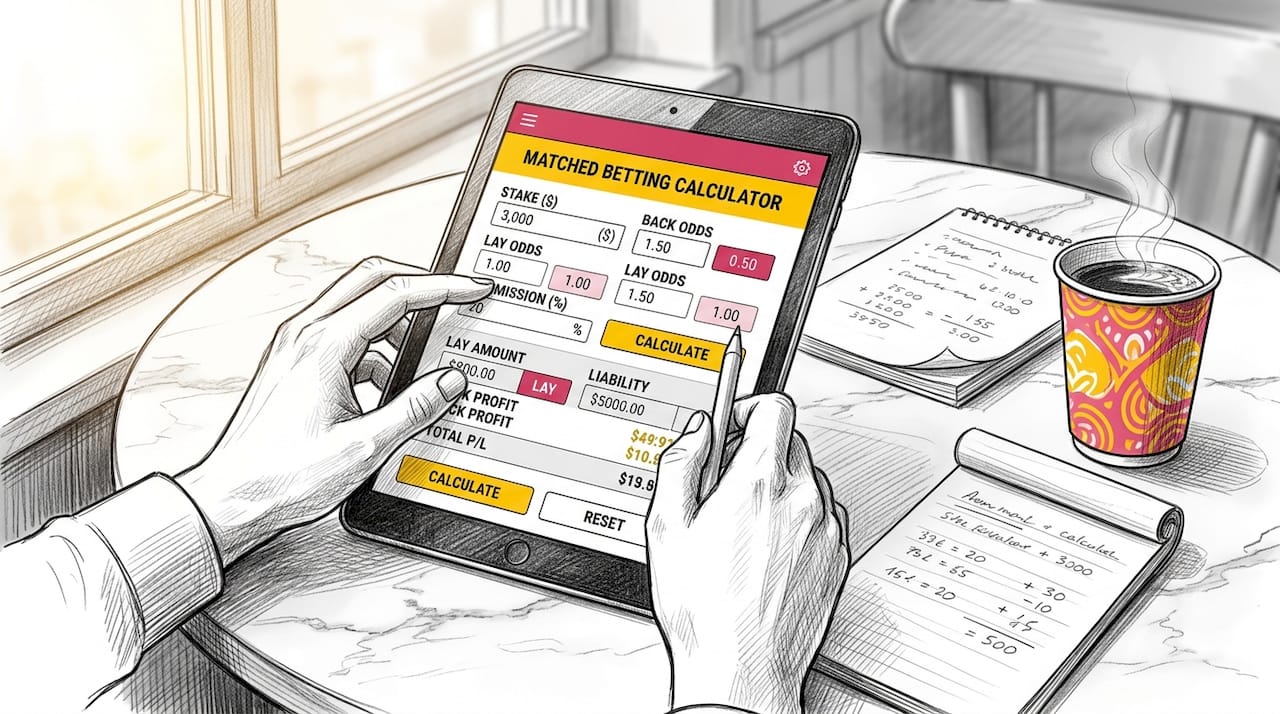
A matched betting calculator handles all the math for you, calculating the exact lay stake needed to minimize losses and maximize profit from each free bet. No manual calculations needed.
Pro Tip: Always run your numbers through a calculator before placing any bet. Even a small mismatch between back and lay odds can turn a guaranteed profit into an unexpected loss if the stakes are not sized correctly.
The key term to understand here is the qualifying bet. This is the initial bet you place to unlock the free bet offer. You can learn more about how qualifying bets work in the qualifying bets guide on Thinkbonus. The qualifying loss is typically small, and the free bet profit more than covers it.
Key differences between matched betting and traditional gambling
The contrast between matched betting and casino or sports gambling is stark once you lay them side by side.
| Factor | Traditional gambling | Matched betting |
|---|---|---|
| Outcome dependency | Win or lose based on chance | All outcomes covered mathematically |
| Profit source | Luck, odds, or predictions | Bookmaker promotions and free bets |
| Risk level | High. Full stake at risk | Low. Qualifying loss is small and planned |
| Predictability | Uncertain by design | Mathematically predictable |
| Long-term result | House edge means consistent losses | Consistent profit from promotions |
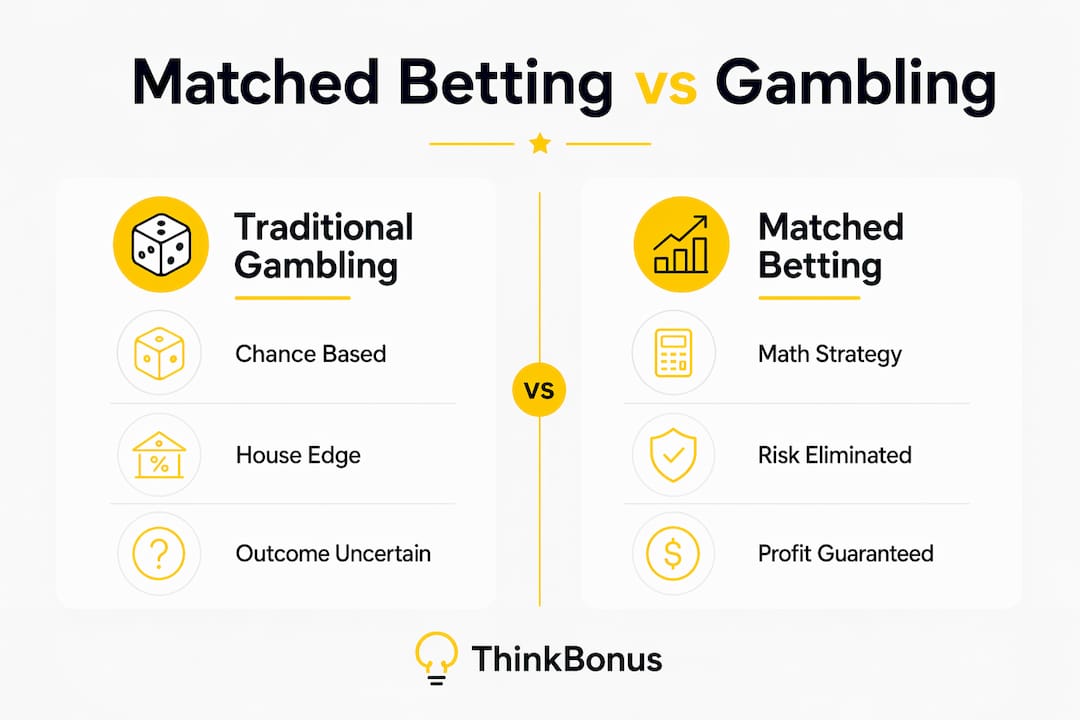
Traditional gambling is designed so the house wins over time. Every casino game, slot machine, and sportsbook is built with a margin that favors the operator. Matched betting flips this relationship. You are not competing against the house. You are extracting value from the promotional budget the bookmaker uses to attract new customers. The bookmaker takes a short-term hit on the free bet, hoping you will stay and gamble. You take the free bet profit and move on.
Matched betting guarantees profit or, at worst, a small qualifying loss due to initial bets, unlike gambling where outcomes are uncertain and losses can be large. That guarantee is the clearest proof that matched betting and gambling are fundamentally different activities.
Human error and bookmaker account restrictions are real risks in matched betting, but they are operational risks, not gambling risks. You are not risking money on an uncertain outcome. You are managing a process, and that process can be done correctly or incorrectly. That distinction matters.
How 2026 regulatory changes affect matched betting offers
The UK Gambling Commission introduced significant rule changes in January 2026 that every matched bettor using UK bookmakers should understand. The UKGC’s 2026 rules limit wagering requirements to 10x and ban mixed-product promotional offers combining different gambling types. This directly affects how bookmakers can structure the free bets and bonuses that matched betting relies on.
Here is what these changes mean in practice:
- Wagering caps at 10x reduce the total amount you need to bet through a bonus before withdrawing, which sounds helpful but also limits the size and complexity of offers available.
- Mixed-product bans mean bookmakers can no longer combine casino bonuses with sportsbook offers in a single promotion. Matched bettors who relied on cross-product deals will find fewer of those opportunities available.
- Free-to-play game restrictions are also affected. The 2026 UKGC rules ban promotions that mix product types even in free-to-play games, ensuring customers must have full freedom of product choice with credits or bonuses.
- Offer availability shrinks as operators redesign their promotions to comply, meaning the pool of usable matched betting opportunities is smaller than it was in 2024 or 2025.
“Regulatory and bookmaker term changes can create strategic cliffs where previously available matched betting offers become unusable, challenging the practical execution of risk-free matched betting.” — UKGC Caps Bonus Wagering
For Canadian bettors who access UK bookmaker platforms, these changes are directly relevant. Operators design promotions to attract and retain customers, and regulatory restrictions have tightened offerings to reduce harmful gambling incentives. The practical result is that matched bettors need to stay current with which offers are still usable and which have been restructured in ways that reduce their value.
Common risks and pitfalls in matched betting
Matched betting is low risk, but it is not zero effort. These are the practical risks you need to manage:
- Human error. Entering the wrong stake, backing the wrong team, or placing a bet at the wrong odds can turn a guaranteed profit into a loss. This is the most common reason beginners lose money.
- Bookmaker account restrictions. When bookmakers detect consistent profitable behavior, they may limit your account or close it entirely. This is called “gubbing.” It does not mean you lose money, but it does reduce your future opportunities.
- Exchange liquidity issues. On betting exchanges like Betfair, you need another user to match your lay bet. For niche sports or off-peak hours, there may not be enough liquidity to get your bet matched at the right odds.
- Timing mismatches. Odds change quickly. If you place your back bet and the lay odds shift significantly before you place the lay bet, your coverage is incomplete.
- Promotion changes. Strategy cliffs caused by new wagering limits or banned bonus types can suddenly reduce matched betting efficacy, especially after regulatory updates like those in 2026.
Pro Tip: Place “mug bets” occasionally. These are small, normal-looking bets on popular sports that make your account look like a regular bettor’s account. This reduces the chance of getting gubbed and extends the life of your most valuable bookmaker accounts.
Using matched betting calculators and careful checking mitigates errors. Bookmaker account closures can limit betting opportunities but do not introduce the risk of losing your entire stake. The risks here are operational, not gambling-related.
Is matched betting truly low risk? Evaluating realistic exposure
Matched betting is genuinely low risk, but calling it completely risk-free requires one important condition: you must follow the process correctly every single time. The math is sound. The risk of losing money on a correctly executed matched bet is essentially zero. The real-world risks come from execution, not from the strategy itself.
Bookmaker policies change. Promotions get restructured. Regulatory updates like the 2026 UKGC changes reduce the number of usable offers. Matched betting relies on strict adherence to matching bets for all outcomes. Missteps or changes in bookmaker promotions can erode the “not gambling” status operationally, even if the math remains true. This means staying informed is part of the strategy.
The most effective risk mitigation approach combines three things: using a reliable calculator every time, keeping detailed records of every bet placed, and staying current with offer changes. Thinkbonus provides updated tools and guides specifically designed to help you do all three without needing to track everything manually. The discipline required is modest compared to the consistent returns matched betting produces when done right.
Key takeaways
Matched betting is not gambling because it uses mathematical bet coverage to eliminate outcome risk, with profit coming entirely from bookmaker promotions rather than chance.
| Point | Details |
|---|---|
| Not gambling by definition | Matched betting covers all outcomes mathematically, removing reliance on chance or luck. |
| Profit source is promotions | Free bets and deposit bonuses from bookmakers generate profit, not predictions or odds. |
| 2026 regulations reduce offers | UKGC rules cap wagering at 10x and ban mixed-product promos, shrinking available opportunities. |
| Operational risks are manageable | Human error, gubbing, and liquidity issues are real but controlled through calculators and discipline. |
| Low risk with correct execution | The strategy is near risk-free when every bet is matched correctly and promotions are verified. |
My honest assessment after years of matched betting
I have been doing matched betting long enough to say with confidence that the “not gambling” label is accurate, but it requires you to take it seriously as a process rather than a passive income tap. The math does not lie. When I first started, I was skeptical that covering both sides of a bet could genuinely produce profit. Then I ran the numbers on a simple free bet offer, placed the bets correctly, and watched the profit land regardless of the game result. That moment makes the concept click in a way no explanation fully can.
What I have learned since then is that the biggest threats to matched betting are not the bets themselves. They are complacency and regulatory drift. Bookmakers are not passive. They watch account patterns, and they adjust. The 2026 UKGC changes have already reshaped the offer pool in ways that require more careful selection of which promotions to use. Mixed-product deals that used to be reliable are gone. Wagering caps have changed the math on some casino-linked offers.
My advice: treat matched betting like a part-time job that pays well when you show up prepared. Use a calculator every single time. Keep records. Read the terms of every offer before you commit. And stay updated on regulatory changes, because the landscape shifts and the bettors who adapt are the ones who keep earning. This is not gambling. It is applied math with a bookmaker’s promotional budget as your raw material.
— Mantas
Start matched betting the right way with Thinkbonus
If you are ready to put this into practice, Thinkbonus has everything you need in one place. The matched betting guide walks you through every step from your first qualifying bet to advanced strategies for maximizing free bet value. For the math side, the matched betting calculator calculates your exact lay stake instantly so you never have to guess.
Thinkbonus also keeps its offer listings updated to reflect current bookmaker promotions, including changes driven by the 2026 UKGC regulations. Whether you are just starting out or looking to sharpen your approach, the tools and guides on Thinkbonus are built to help you profit consistently and confidently.
FAQ
What makes matched betting different from gambling?
Matched betting covers every possible outcome of an event using coordinated back and lay bets, so the result does not affect your profit. Traditional gambling requires a specific outcome to win, making it dependent on chance.
Is matched betting legal in Canada?
Matched betting uses legal bookmaker promotions and betting exchanges. It is based on mathematical strategy rather than chance, and it involves exploiting bookmaker promotions, not breaking any laws. Canadian bettors using licensed platforms operate within legal boundaries.
How much can you lose doing matched betting?
The only planned loss in matched betting is the qualifying loss on the initial bet, which is typically small and calculated in advance. Profitability comes from the bookmaker’s promotional money, not from betting outcomes, so correctly executed matched bets do not produce large losses.
Do the 2026 UKGC changes affect matched betting profits?
Yes. The new rules cap wagering requirements at 10x and ban mixed-product promotional offers, which reduces the number and variety of usable matched betting opportunities. Bettors need to verify that current offers still meet the criteria for profitable matched betting before placing bets.
What is the biggest risk in matched betting?
Human error is the most common cause of losses in matched betting. Entering the wrong stake or odds can break the coverage of all outcomes. Using a matched betting calculator and double-checking every bet before placing it eliminates most of this risk.