














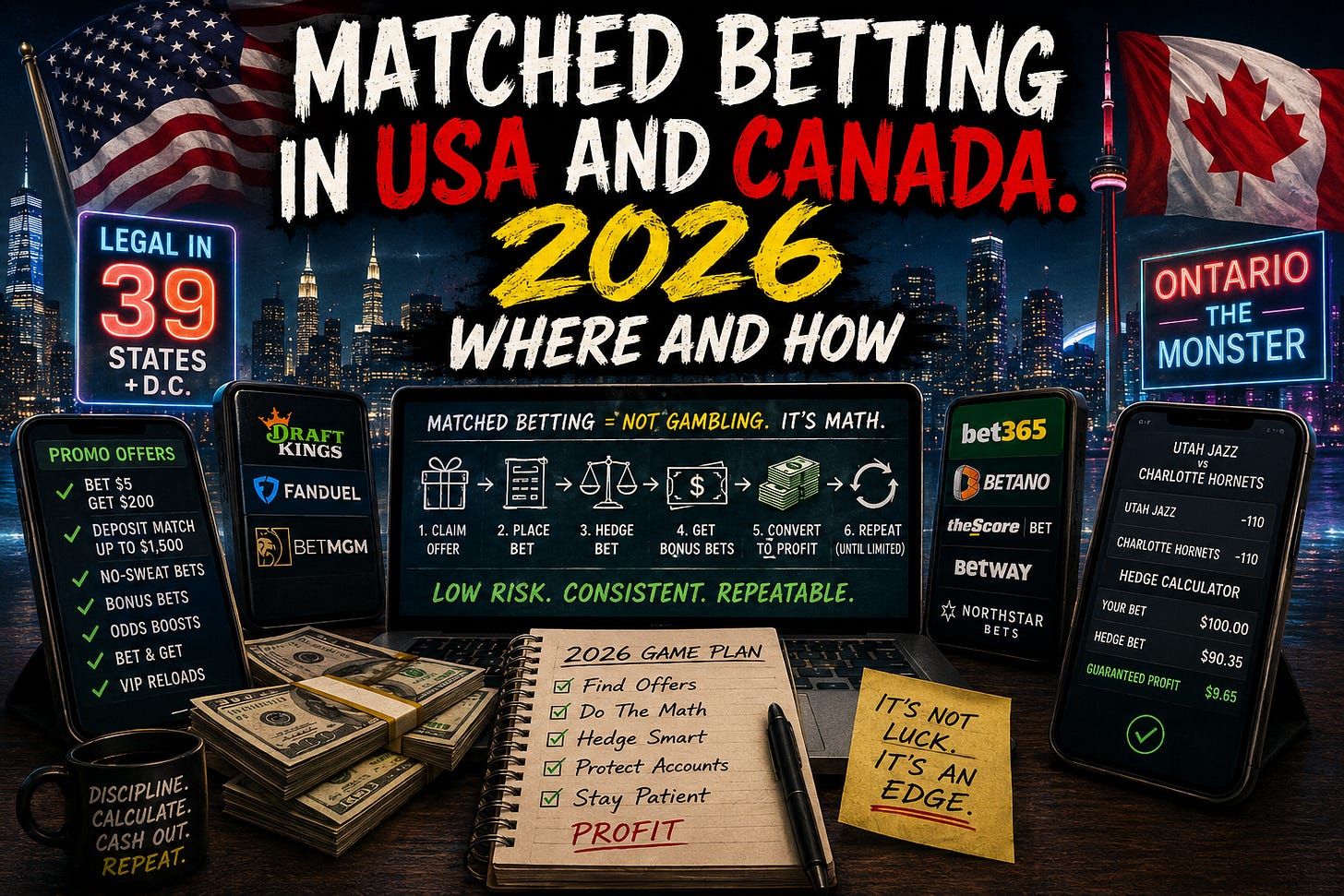
Matched betting in North America during 2026 feels like standing inside a gold rush powered by algorithms, desperation, and investor cash burn.
The opportunity is still real.
There’s a moment — usually around 2:14 a.m. — when you’re sitting in your underwear, three browser tabs deep into a hedge calculator, watching a meaningless Utah Jazz vs. Charlotte Hornets game, and suddenly realizing something extraordinary:
The casinos are paying you.
Not because you’re lucky.
Not because you’re a genius.
Not because you’ve developed supernatural insight into Korean baseball or Belarusian table tennis.
No. They’re paying you because the North American sportsbook industry in 2026 has become a deranged promo war fueled by venture capital, state-by-state legalization, and executives who believe “customer acquisition” is a sacred ritual requiring rivers of bonus bets and shareholder blood.
And right there, in the middle of the digital carnage, stands matched betting.
Calm. Mechanical. Ruthless.
Like counting cards in Vegas, except nobody throws you out immediately.
The Great North American Gold Rush
The United States sports betting market now resembles a cyberpunk frontier town where every sportsbook operator is firing free bets from T-shirt cannons into crowds of emotionally compromised NFL fans.
As of 2026, sports betting is legal in 39 U.S. states plus Washington D.C., with most major markets offering full mobile betting.
And this matters because matched betting feeds on competition.
More sportsbooks = more signup bonuses.
More desperation = more reload promos.
More states legalizing = more operators trying to buy market share with absurd offers.
The kings of this chaos are still the familiar monsters:
-
DraftKings
-
FanDuel
-
BetMGM
-
Caesars Sportsbook
-
Fanatics Sportsbook
-
bet365
Every single one of them wants your soul, your deposits, your dopamine receptors, and ideally your inability to understand rollover requirements.
Matched bettors simply smile politely and extract the bonuses with surgical precision.
So Where Can You Actually Do Matched Betting in 2026?
USA: The Sweet Spots
If you’re physically located in states like:
-
New Jersey
-
New York
-
Pennsylvania
-
Michigan
-
Colorado
-
Ohio
…then congratulations. You are standing in a promotional hurricane.
These states have dense sportsbook ecosystems with overlapping offers, boosted odds, “bet $5 get $200” nonsense, no-sweat bets, and recurring promos stacked like unstable Jenga towers.
Meanwhile, states with limited operators or retail-only betting are tougher terrain. You can still matched bet there, but it’s more like scavenging after the buffet closed.
Missouri’s launch in late 2025 added another feeding ground for promo hunters.
Canada: Ontario Is the Monster
Canada is a different beast entirely.
Outside Ontario, things remain provincial, fragmented, and often boring.
But Ontario? Ontario has become the Las Vegas of Canadian matched betting.
After regulation opened the market, sportsbooks stormed the province like invading armies with promo codes.
In Ontario, matched bettors now juggle accounts across:
-
Betano
-
Betway
-
theScore Bet
-
NorthStar Bets
-
the American giants
-
random newcomers with venture-backed death wishes
Alberta is expected to launch a regulated market in 2026, which could create another juicy expansion phase.
And expansion phases are where the money lives.
The Secret Nobody Tells Beginners
Matched betting is not gambling.
This drives gamblers insane.
Because gamblers want the mythology:
-
intuition
-
hot streaks
-
“locks”
-
“inside information”
-
a cousin who “knows hockey”
Matched betting is bookkeeping with adrenaline flavoring.
You are exploiting promotional inefficiency.
That’s it.
A typical sequence looks like this:
-
Sportsbook offers “Bet $5, Get $200.”
-
You place a qualifying bet.
-
You hedge the opposite side elsewhere.
-
You receive bonus bets.
-
You convert bonus bets into withdrawable cash using calculated hedges.
-
You repeat until the sportsbook realizes you are not the type of customer who parlays Lithuanian basketball into financial ruin.
The math isn’t glamorous. But it works.
And in 2026, the offers are still absurd.
Promos currently circulating include:
-
deposit matches up to $1,500
-
no-sweat bets
-
bonus bet ladders
-
FanCash rewards
-
daily insurance promos
-
“bet and get” offers during NFL, NBA, March Madness, and Olympics cycles
The Real Enemy: Limiting
Eventually, the sportsbooks notice.
Not immediately. Not dramatically.
One day your odds boosts disappear.
Then your max stake gets weirdly small.
Then suddenly you can only wager enough money to buy half a sandwich.
Welcome to “gubbing.”
Ontario bettors discuss this constantly.
The sportsbooks don’t hate winners. They hate predictable extractors.
And matched bettors are exactly that.
So the modern 2026 strategy has evolved.
The sharp operators now:
-
mix recreational bets
-
avoid perfect hedge timing
-
use casino promos occasionally
-
avoid smashing every obvious arb
-
rotate books carefully
-
preserve accounts like aging Formula 1 engines
Because longevity matters more than one glorious weekend of promo slaughter.
The New Meta: Promo Cycling
The real professionals in 2026 aren’t just doing signup bonuses anymore.
Everybody knows the signup phase.
The deeper game is:
-
reload offers
-
profit boosts
-
same-game parlay insurance
-
NBA live betting boosts
-
“bet and get” streaks
-
VIP reloads
-
seasonal events like Super Bowl and March Madness
There are bettors quietly extracting thousands annually from recurring promotions.
Not Lamborghinis.
Not crypto fantasy nonsense.
Just reliable, repeatable side income harvested from the irrational economics of modern online gambling.
A beautiful thing.
Final Thoughts From the Neon Wasteland
Matched betting in North America during 2026 feels like standing inside a gold rush powered by algorithms, desperation, and investor cash burn.
The opportunity is still real.
But it’s changing.
The easy years are disappearing. Sportsbooks are smarter. Limiting is harsher. Promo abuse detection is evolving. The ecosystem is maturing.
Still — if you are in the right U.S. state or inside Ontario, disciplined matched betting remains one of the strangest legal edges on the internet.
A bizarre loophole where corporations spend billions trying to manufacture gambling addiction…
…and accidentally create a spreadsheet-based side hustle for people willing to learn odds conversion at 1:47 a.m. while eating cold pizza and hedging an Icelandic handball match.
God bless capitalism.